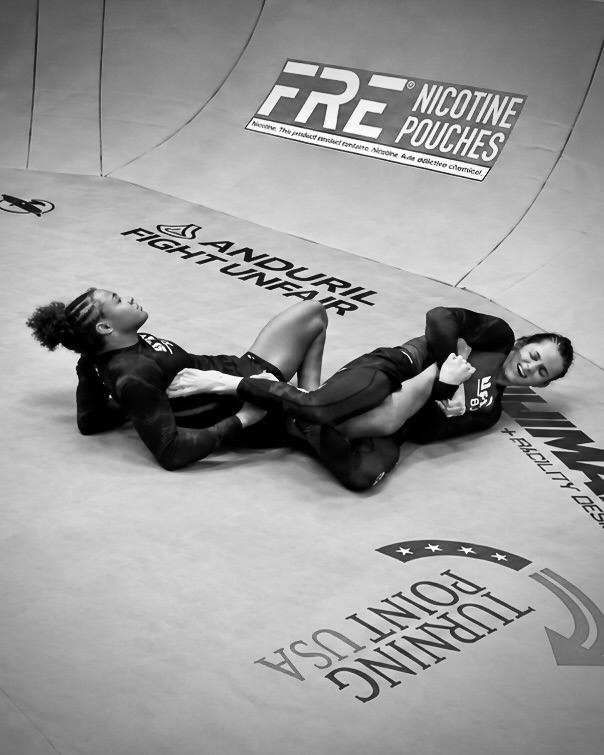
Cassia Moura left UFC BJJ 12 with a second belt. Adele Fornarino left with a result that was difficult to reconcile with the most dangerous offense of their fight.
Moura’s split-decision victory made her the promotion’s first two-division champion. But the question the match left behind was more fundamental than who carried the hardware: did the judges give submission threats the weight UFC BJJ’s own rules demand?
What was the first round worth?
The first four minutes were fairly even. The final minute was dramatically different.
Fornarino secured deep leg attacks, culminating in an exceptionally tight heel hook as time expired. Moura looked close to tapping. The horn ended the exchange before the submission could be resolved.
The case for a 10–8 rests on the severity of that final minute, rather than dominance across all five. When the preceding action is closely contested, how much weight should a sequence that nearly ends the fight carry?
UFC BJJ’s published criteria place effective submission attempts requiring meaningful defense first, offensive advances toward a finish second, and duration of control third. Yet its 10–8 language describes overwhelming dominance throughout the round. Fornarino’s performance exposes the tension between those provisions: the most consequential offense can arrive in a concentrated burst.
MMA offers a useful comparison. Its judging guidance explicitly says a 10–8 does not require five minutes of domination; significant impact can warrant consideration of a wider margin even when the decisive sequence is shorter. UFC BJJ uses different wording, but should a deeply secured submission receive less weight because it occupies the final minute of an otherwise even round?
Moura’s takedown and back take gave her a stronger second round, though she produced no comparable submission threat. The third was closer: Moura scored a takedown, but spent substantial time in Fornarino’s half guard while Fornarino continued creating offense and reached another dangerous leg entanglement.
Describing that exchange simply as Moura being “on top” misses what matters. Relative hip position, the control of an opponent’s movement and the attacks each athlete can generate tell us more than whose torso appears above whose. A grappler working from underneath can be the one dictating the exchange and forcing urgent defense.
Which athlete was progressing toward a finish, and which was responding to the danger? That is the more useful question. Moura’s takedown deserved credit, but Fornarino’s subsequent submission offense deserved the greater weight assigned to it by the criteria.
That is why 29–27 for Fornarino—10–8, 9–10, 10–9—is the more persuasive reading of the fight. Even giving Moura the third yields 28–28 if the first receives a 10–8. At best for Moura, a draw on that assessment. Fornarino’s third-round offense makes the stronger case for a win.
Moura’s eye poke and the repeated instructions for her to engage raised additional officiating questions. The argument for Fornarino does not require deductions for either.
Jones’ criticism gets to the central issue
Craig Jones also challenged the officiating. BJJDoc’s October 9 report describes him sharing an image said to show a first-round 10–8 for Fornarino changed to 10–9 on a judge’s card, alongside criticism of the promotion’s direction.
A changed mark does not establish its timing or reason. But Jones’ reported reaction draws attention to precisely the question that needs answering: how was Fornarino’s first-round offense valued?
MMA Mania’s Anton Tabuena likewise argued that the deep heel hooks warranted a 10–8 and that a draw should have been Fornarino’s worst outcome. His analysis and Jones’ reported criticism reinforce the concern that the result undervalued the match’s clearest finishing threats.
Can ten-point-must reward the right things?
The format can produce fair results. Routinely treating every round as 10–9 makes that harder.
Win one round decisively and lose two narrowly, and three 10–9 scores produce a 29–28 defeat. Give the dominant round a 10–8 and the same sequence produces a draw. That single point determines whether the scoring recognizes a substantial difference in effective offense.
The round breaks also matter. A horn can interrupt a submission built through minutes of work and give the defender a fresh start. When the clock stops an attack, the score should still reflect what preceded it.
More rounds might give title contenders greater opportunity to separate themselves. They would not solve inconsistent judging. UFC BJJ needs clear examples of what warrants wider margins—including how to assess an otherwise even round transformed by a late near-finish—judges who recognize dangerous offense from either position, and explanations that make disputed scorecards intelligible.
Fornarino’s loss raises those questions sharply. The rest of the card deserves attention, too.
Canuto finished his championship climb
The main-event argument should not swallow Renato Canuto’s achievement. He beat Ethan Crelinsten by unanimous decision to capture the vacant lightweight championship.
Canuto brought an established championship résumé into the Bowl: a black-belt IBJJF no-gi world title in 2017, a gi world title in 2021 and KASAI Grand Prix championships. His athletic, inventive style has long been backed by results.
His UFC BJJ title came through recovery. Andrew Tackett submitted him in his first attempt at welterweight gold. Canuto returned with decision wins over Alan Sanchez and Yonathan Cardenas, then took his next championship opportunity at lightweight.
He had experienced the disappointment of losing on this stage. This time, he left with the belt.
For Crelinsten, the result carries the frustration of seeing an opportunity within reach and watching someone else take it. His ability makes those moments particularly compelling: there is good reason to expect him to win.
His Polaris record explains why. Crelinsten has already won and defended its lightweight championship. In March, he submitted Shai Gerena at Polaris 36 and publicly called for a UFC BJJ opportunity. He then submitted Danilo Moreira in his UFC BJJ debut.
He had pursued this belt, earned his place in the title match and arrived with a credible record of championship success. Canuto stopped that pursuit at its most consequential moment.
Crelinsten’s loss makes him an interesting contender to follow. Canuto’s victory gives the division an accomplished champion whose performance deserves attention in its own right.
Burns brought the history. Almeida supplied the finish.
Gabriel Almeida submitted Gilbert Burns with a first-round heel hook. The significance of that finish begins with the opponent’s history, but it belongs to Almeida.
Burns was a world-class grappler before he became a familiar UFC name. He won an IBJJF gi world title in 2011 and no-gi world titles in 2010 and 2013. His MMA career took him to a welterweight championship challenge against Kamaru Usman, with victories over Tyron Woodley, Stephen Thompson, Demian Maia and Jorge Masvidal.
Few athletes connect those audiences so naturally. Jiu-jitsu followers remember the world champion. MMA fans recognize a fighter who tested himself against leading welterweights of his era. His presence gives a submission-grappling event a reason to matter to viewers beyond its usual audience.
That recognition also creates an opportunity for the man across from him.
Burns attacked a takedown and escaped an early guillotine threat before Almeida eventually reached the finishing leg attack. Almeida handed Burns his first UFC BJJ defeat after Burns had submitted Horlando Monteiro in his debut.
Past championships do not shield an athlete from current competition. Preparing for MMA also demands a different allocation of training than specializing in submission grappling. Those distinctions give Burns’ return context without explaining away this result.
Almeida secured the finish against a decorated opponent. For viewers who arrived knowing only Burns, he supplied a reason to remember Gabriel Almeida.
Burns’ career retains its importance. Almeida’s performance earns its place alongside it.
Five submissions, all in the first round
Thaynara Victoria finished Danielle Kelly with an armbar in the opening round, adding another decisive victory over a recognizable opponent.
Landon Elmore submitted Max Livingston with a foot lock. Kade Anastasios heel-hooked Ataide Rafael, and Raphael Ferreira finished Kyle O’Hare with the same submission. Both heel hooks also came in round one. John Chandler defeated Raphael Gomez by unanimous decision.
Five of eight bouts ended by submission, all in the first round. Four finishes came through lower-body attacks.
Those results underscore the stakes of the main-event argument. A leg attack that produces a tap is easy to recognize on a results sheet. Assessing how close an unfinished attack came requires more expertise, but its effectiveness still matters.
UFC BJJ 12 produced a new lightweight champion, significant finishes and another chapter for an accomplished veteran. The athletes gave the evening substance.
The judges’ decision in the main event left the hardest question behind: can the promotion consistently translate effective grappling into a credible score?
Fornarino’s submission offense deserved more weight than it received. Until UFC BJJ can explain how that performance became a defeat, the result will remain harder to accept than the fight was to understand.