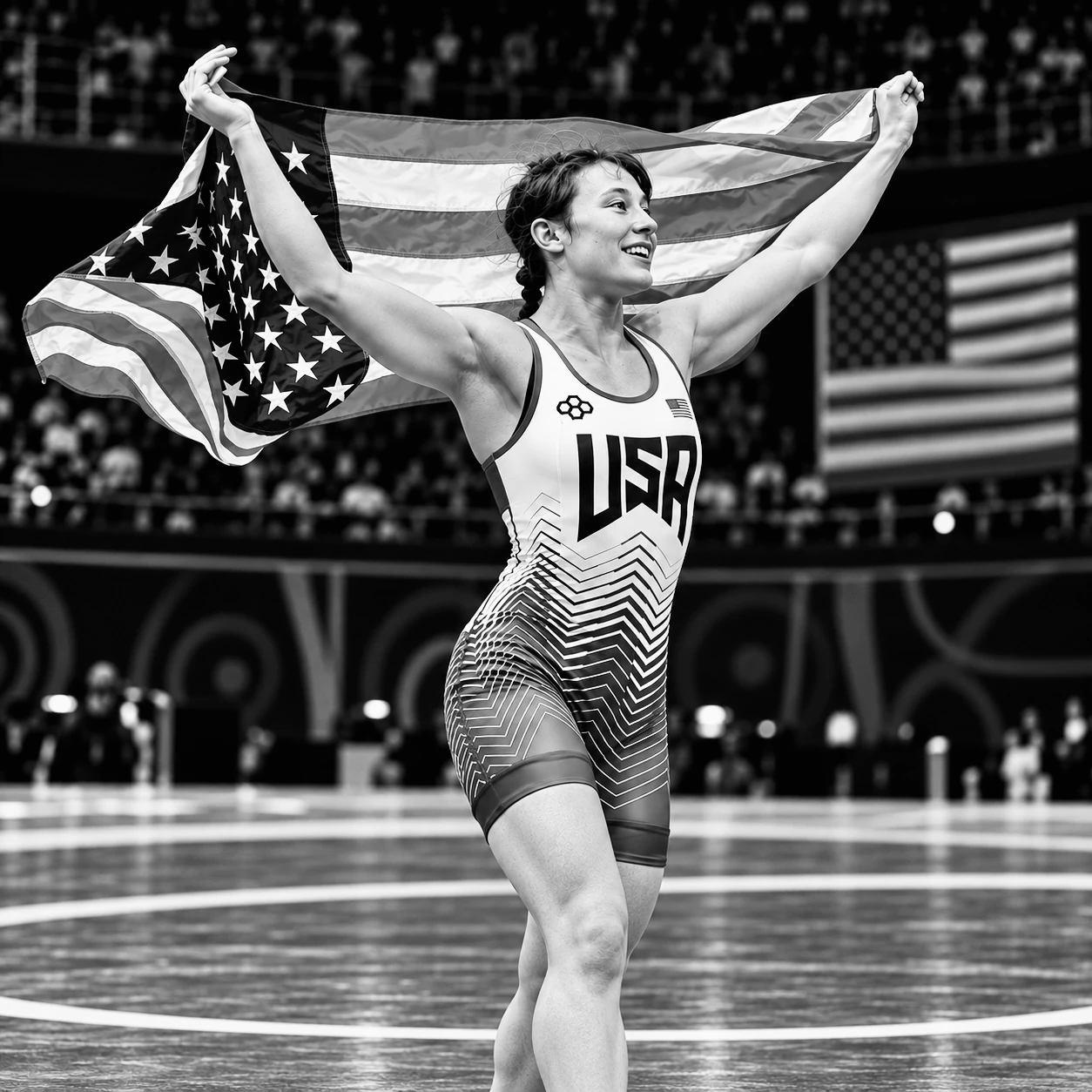
Everest Leydecker trailed at the break in her U20 world final. By the end, she had pinned her opponent and secured a second consecutive championship. Her result at 55 kilograms gave the United States its gold medal in women’s freestyle in Bratislava and a clear example of the composure required to turn an international final.
Japan’s Nana Kozuka held a 2–1 advantage after the opening period. Leydecker countered an attack early in the second, established the position she needed and eventually secured the fall. A difficult opening had become another world title.
Around that championship, the U.S. assembled a four-medal tournament. Morgan Turner earned bronze at 50 kilograms. Caley Graber added bronze at 59, and Taina Fernandez did the same at 68. The Americans finished fourth in the team standings with 118 points, behind Japan, India and China. Every U.S. entrant placed in the top ten.
Graber’s first age-group Worlds offered a particularly revealing path. Her only loss came on criteria to eventual champion Sae Noguchi. She returned to pin Mongolia’s Gundegmaa Enkhbaatar for bronze, completing a tournament that combined a narrow setback with a decisive response.
Fernandez arrived with three U17 world titles and still had to work back from an opening loss. She finished with a 4–0 bronze-medal victory over Evangeliia Berezhnova. Turner’s bronze gave her a fourth age-group world medal. Their results illustrate how demanding the transition can be even for athletes already accustomed to winning internationally.
That is the useful way to read this American team. Leydecker’s repeat title demonstrates continuity at the top. The bronze medals demonstrate the value of remaining competitive after the original route to gold closes. Fourth place also leaves a clear measure of how much work remains against the leading nations.
For wrestlers coming through American high schools, these are the careers to follow closely. The distance between an age-group national title and a sustained international career contains difficult adjustments. New opponents expose familiar strengths. Close matches make tactical decisions more expensive. The ability to recover becomes part of the competitive skill set.
Texas has a direct stake in that development even when a particular U20 medalist comes from elsewhere. The state’s growing girls’ programs need visible examples of what follows high school success, and athletes need to see that progress includes both championships and demanding returns through the bracket.
Bratislava supplied both. Leydecker stood at the top again. Turner, Graber and Fernandez made sure their tournaments ended on the podium. Together, they gave the next group of American women a demanding, credible standard.