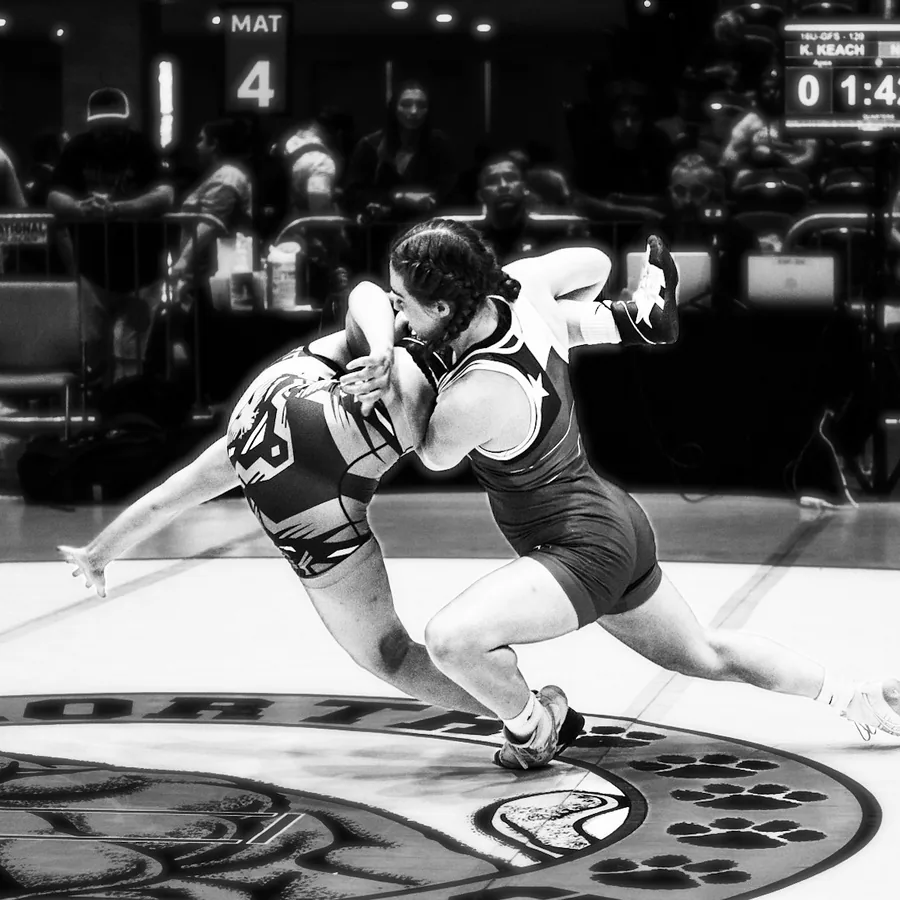
Wrestling has always sold itself as one of the purest sports in the world. No ball. No bat. No equipment advantage. No place to hide. Just two athletes, discipline, toughness, technique, and the willingness to keep fighting when everything in your body is telling you to quit.
For generations, that image was almost always framed through boys and men. Wrestling rooms were built around them. High school programs were built around them. College opportunities were built around them. The Olympic dream was built mostly around them.
But the fastest-changing part of wrestling in America today is not the preservation of that old image. It is the rise of girls and women who are reshaping it.
Women's wrestling is no longer a side story. It is not a novelty. It is not a small division tucked into the back of a tournament. It is one of the strongest signs that wrestling is growing, modernizing, and reaching athletes it failed to fully serve for decades.
The numbers make that impossible to ignore.
During the 2024–25 school year, more than 74,000 girls participated in high school wrestling across more than 8,000 schools. Ten years earlier, that number was just over 11,000. That means girls high school wrestling has grown more than sixfold in a decade.
That is not normal growth. That is a movement.
The growth is also not just happening in isolated pockets. More state associations are sanctioning girls wrestling. More schools are creating girls teams. More girls are getting their own postseason opportunities instead of being forced to compete only in boys brackets. A sport that once asked girls to fit into a structure built for someone else is now being forced to build a structure worthy of them.
That matters because opportunity changes everything.
For years, girls who wanted to wrestle often had to be unusually stubborn just to stay in the sport. They had to walk into rooms where they were the only girl. They had to answer the same questions over and over. They had to prove they belonged before they were coached, supported, or taken seriously. Many did it anyway.
Now, a young girl walking into a wrestling room can see a different future. She can see girls state champions. She can see college programs. She can see NCAA athletes. She can see Olympians. She can see world champions. She can see a path.
That path became even clearer when the NCAA officially added women's wrestling as its 91st championship sport. The decision marked a major turning point for the sport in the United States. Women's wrestling moved from an emerging opportunity to an official NCAA championship pathway. That is a historic shift.
"The question is no longer whether girls want to wrestle. That has already been answered."
For female wrestlers, the NCAA's decision means more than a new tournament. It means legitimacy. It means recruiting. It means scholarships. It means institutional investment. It means athletic departments can no longer treat women's wrestling as a fringe experiment. It means high school girls can pursue wrestling with the same kind of long-term athletic goals that boys have had for generations.
The impact reaches beyond college athletics.
Women's wrestling also played an important role in the sport's Olympic survival and modernization. In 2013, wrestling was nearly removed from the Olympic program. The decision shocked the wrestling world. Wrestling had been part of the ancient Olympic Games and was one of the foundational sports of the modern Olympic movement. Yet the International Olympic Committee questioned whether the sport had done enough to modernize, grow, and appeal to a changing global audience.
Wrestling survived, but it did not survive by refusing to change.
The international wrestling community responded with major reforms. Leadership changed. Rules were adjusted. Matches were made easier to understand. Athletes were given a greater voice. Women were given a larger role in the sport's governance. Additional Olympic weight classes were added for women's freestyle wrestling.
It would be inaccurate to say women's wrestling alone saved Olympic wrestling. But it is entirely fair to say that women's wrestling became central to the argument that wrestling still had a future. The sport had to prove that it was not merely defending tradition. It had to prove that it could grow. Women's wrestling helped prove exactly that.
That is the bigger story. The rise of women's wrestling is not only about participation numbers. It is about what those numbers reveal. They show that wrestling's future is bigger than its past. They show that the sport can reach athletes who were once overlooked. They show that when real opportunities are created, girls do not need to be convinced to wrestle. They show up.
And they do more than show up. They compete. They train. They win. They build programs. They fill brackets. They raise the standard. They change the culture of the room.
That cultural shift may be the most important part of all.
Wrestling has always claimed to be a sport for anyone willing to work. Women's wrestling is forcing the sport to live up to that claim. It is forcing schools to examine whether girls have equal access to coaching, practice space, competition schedules, travel opportunities, media coverage, and administrative support. It is forcing programs to ask whether they are truly developing girls wrestling or merely allowing it to exist.
"Allowing girls to wrestle is not the same thing as investing in them."
There is a difference. Allowing girls to wrestle is not the same thing as investing in them. Letting girls join a room is not the same thing as building a program. Celebrating girls after they win is not the same thing as giving them the resources needed to win in the first place.
That is where the next chapter will be written.
The question is no longer whether girls want to wrestle. That has already been answered. The question is whether schools, clubs, state associations, college programs, media outlets, and communities will keep up with the demand.
Because the rise of women's wrestling is not coming. It is already here.
And if the people in charge of the sport are paying attention, they will understand something important: girls are not just participating in wrestling's growth. They are driving it.