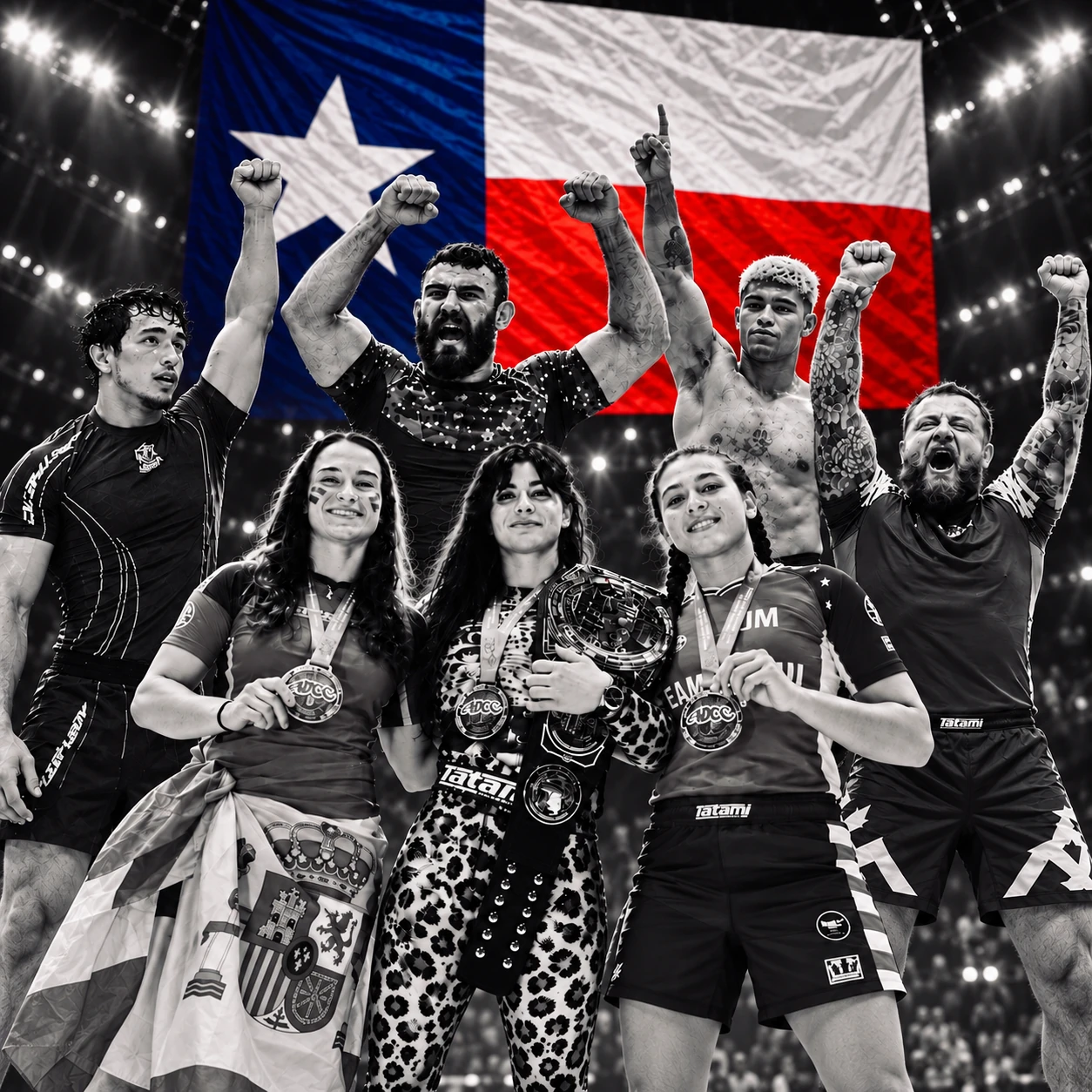
Three of the clearest Texas training-room stories at ADCC 2026 ended with world titles. Helena Crevar and Luke Griffith won for Kingsway. Victor Hugo won for Six Blades. Joslyn Molina added a bronze medal at just 14 years old, giving the weekend another result that reached well beyond the usual expectations attached to a young competitor.
Crevar’s +65 kg championship came through three submissions. Griffith won −99 kg by submitting Kaynan Duarte in the final. Hugo finished all four opponents in the +99 kg bracket. These were distinct achievements, earned by athletes with different backgrounds and different competitive paths. Their shared connection was the training environment that helped prepare them for Kraków.
That distinction matters when describing Texas’s place in the sport. An academy based in Texas is not proof that every athlete representing it grew up in the state. The more meaningful point is that Texas has become a place where established international talent chooses to train alongside developing competitors. Preparation undertaken here can have consequences on the largest stages elsewhere.
Hugo’s connection to that environment was visible before the championship. Six Blades’ ADCC preparation included training in Austin, with a visiting instructor’s account describing work at the headquarters and Lake Travis locations. His world title gives that preparation a concrete competitive outcome without reducing a long career to one camp.
Molina’s result speaks to another part of the same story. She reached the −65 kg semifinals and earned bronze after defeating Mo Black. A medal at that age is exceptional, but it should be understood as her achievement rather than a timetable every young athlete ought to match.
For Texas academies, the useful lesson is about the quality of the daily work. Strong training partners make mistakes harder to hide. Experienced coaches can give an athlete a clearer plan. Frequent competition can reveal whether that plan survives outside familiar rounds. None guarantees a world medal, but each contributes to an environment capable of supporting one.
The state’s grappling community also includes programs that were established long before the recent movement of prominent no-gi teams. This championship should add to that history, not rewrite it around the newest names. Texas’s strength comes from the interaction of longstanding academies, newer elite rooms and competitors at every level.
Kraków gave that broader story several unmistakable results. Crevar, Griffith and Hugo returned with titles. Molina returned with a medal few athletes her age have approached. For those following the sport from Texas, the world championships were both an international event and a report on work taking place much closer to home.