A state ranking is a useful thing to carry into Iowa. It becomes considerably less useful once somebody has your leg.
That is part of the appeal of Preseason Nationals. The opponents are less familiar. The reputations have crossed state lines. A wrestler who spent last winter looking unbeatable at home can find a very different argument waiting in the first round.
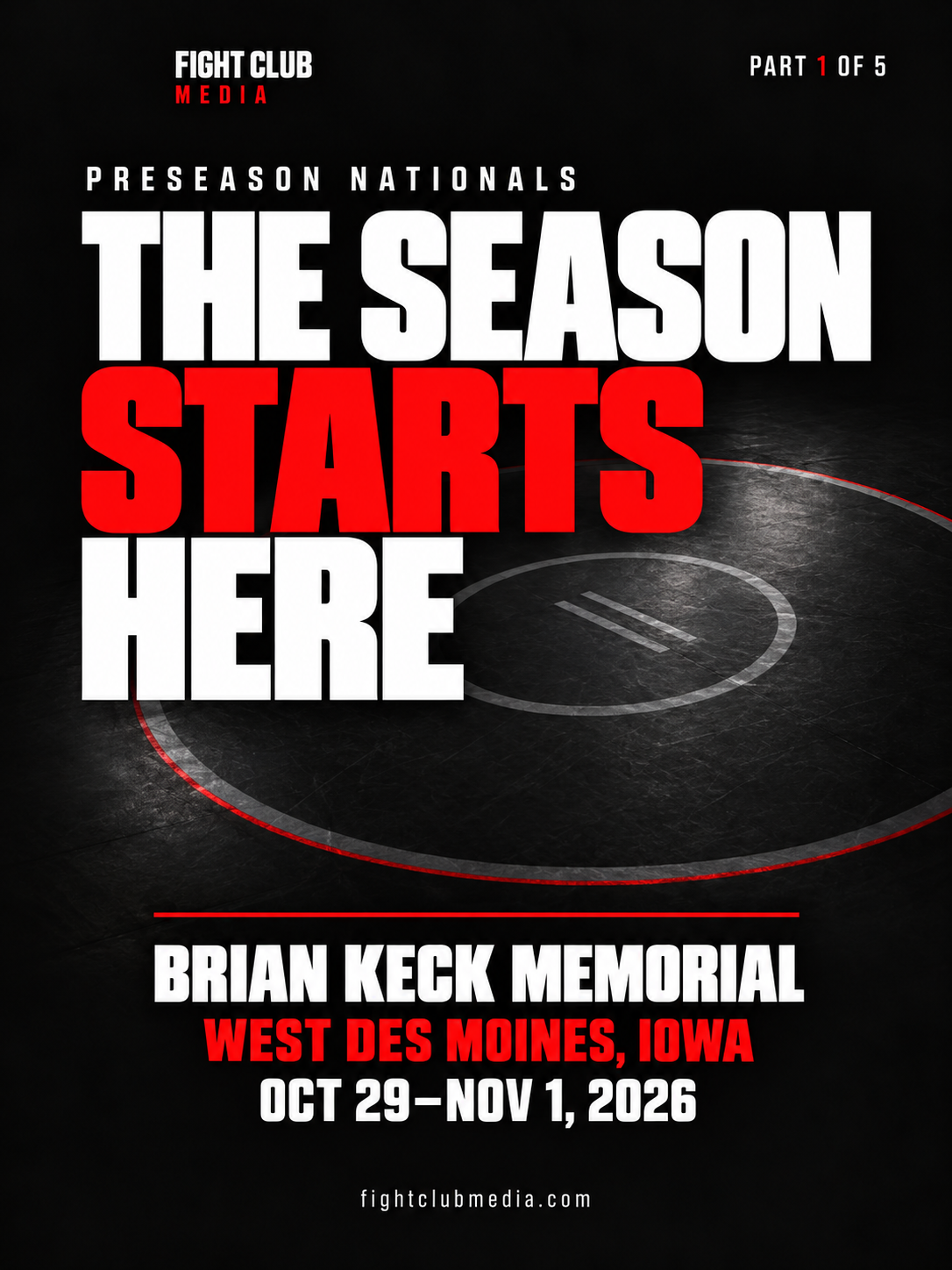
The 2026 U.S. Marine Corps Brian Keck Memorial Preseason Nationals arrives in West Des Moines with plenty of those arguments to settle. USA Wrestling reported more than 4,800 registered competitors on October 23, the second consecutive year the event has passed that mark. Competition runs October 29 through November 1 at the MidAmerican Energy Company RecPlex, opening the organization’s major national-event calendar for the 2026–27 season. USA Wrestling’s event preview
The timing gives the tournament its particular value.
There is a long winter ahead. Enough time to correct weaknesses, change expectations and become a substantially different wrestler. Iowa offers an early look at what already works against national competition, and what only looked reliable in the practice room.
Both are worth the trip.
The name behind the tournament
Brian Keck helped establish Preseason Nationals with USA Wrestling in 2008. Its first edition took place in Des Moines; nine years in Cedar Falls followed before the tournament returned to Des Moines in 2018.
Keck brought more than an event organizer’s interest to the job. An Ohio high school state champion and junior-college national champion, he became a two-time NCAA qualifier at Bloomsburg and competed at the senior level in both freestyle and Greco-Roman. In 1996, he qualified for the U.S. Olympic Trials in both styles.
He died in November 2019 at 48. USA Wrestling named the tournament in his memory the following year. USA Wrestling’s account of Keck’s career and the tournament’s founding
The event’s enduring purpose is straightforward: give ambitious wrestlers a place to test themselves against opponents they would not ordinarily meet.
The medals matter. So does discovering, early enough to do something about it, precisely where your wrestling stands.
Summer credentials, winter questions
Fargo provides valuable evidence. So do state championships, national podiums and the matches that never become a line in an athlete’s biography.
But evidence needs context.
This is a folkstyle tournament. The official rules specify modified NFHS competition for boys and girls, double-elimination brackets with wrestle-backs through eighth place, and style-specific USA Wrestling Performance Index separation. The high school championship bouts use three two-minute periods. Official event rules
That changes what a preview should examine.
A summer freestyle result can tell us plenty about an athlete’s ability to compete. It cannot, by itself, answer every question about bottom wrestling, sustained top control or the choices that decide a close folkstyle match.
Can the wrestler get off bottom when the first stand-up fails? Can she finish the second attack after the opponent stops the first? Can he protect a lead without surrendering the initiative?
Those questions deserve at least as much attention as the number beside a name.
An October result also needs proportion. One outstanding weekend can announce a contender. One difficult draw does not erase an entire body of work. The useful reporting explains the opponents, the circumstances and the wrestling, rather than pretending every placement is a permanent verdict.
Texas needs comparisons, not compliments
For Texas, the opportunity extends beyond collecting medals.
A district championship establishes something meaningful within a district. A regional finish adds another layer. A state podium offers stronger evidence still. A national tournament puts those accomplishments beside athletes who earned theirs somewhere else.
That is where the comparisons become interesting.
Which Texas wrestlers can impose their offense against unfamiliar opposition? Who has improved enough to make last season’s ranking look stale? Which young athletes are already competitive with opponents whose résumés suggest they should not be?
Those are better questions than whether Texas belongs.
They are also more useful when the athletes return home. A result against an established national opponent can change how a local rivalry looks. A difficult weekend can expose a technical problem that would otherwise remain hidden until the postseason.
Our coverage will follow those connections, with particular attention to North Texas, without confusing home-state interest with evidence.
Give the girls the whole story
The girls’ brackets deserve the same scrutiny.
That means examining the actual field, the quality of the wins and the wrestling that separates contenders. It means identifying freshmen who can challenge older opponents, established athletes who have added another dimension, and matches whose significance extends beyond a final score.
A paragraph about the growth of girls’ wrestling will not accomplish that.
The current schedule places the high school girls’ competition across October 31 and November 1, with preliminaries beginning Saturday and medal matches and championship finals scheduled Sunday morning. The separate Boys National Recruiting Showcase runs alongside the broader tournament. Official schedule, subject to change
There will be enough consequential wrestling to warrant more than an afterthought.
What Iowa can tell us
This series begins with the tournament itself: its history, its purpose and the questions worth taking into the building. The coverage that follows will examine the competitors and matchups behind those questions, with registration and current results doing the work that reputation cannot.
The champion’s hand will go up. The bracket will acquire a winner. Those are the easy facts to record.
The more interesting work is recognizing the athlete who leaves Iowa better understood than when they arrived.
Someone will arrive with a ranking that proves justified. Someone will make an impressive résumé look incomplete. Someone largely unknown outside a small circle of coaches and teammates will give the rest of the country a reason to learn a name.
The season is young enough for all three.