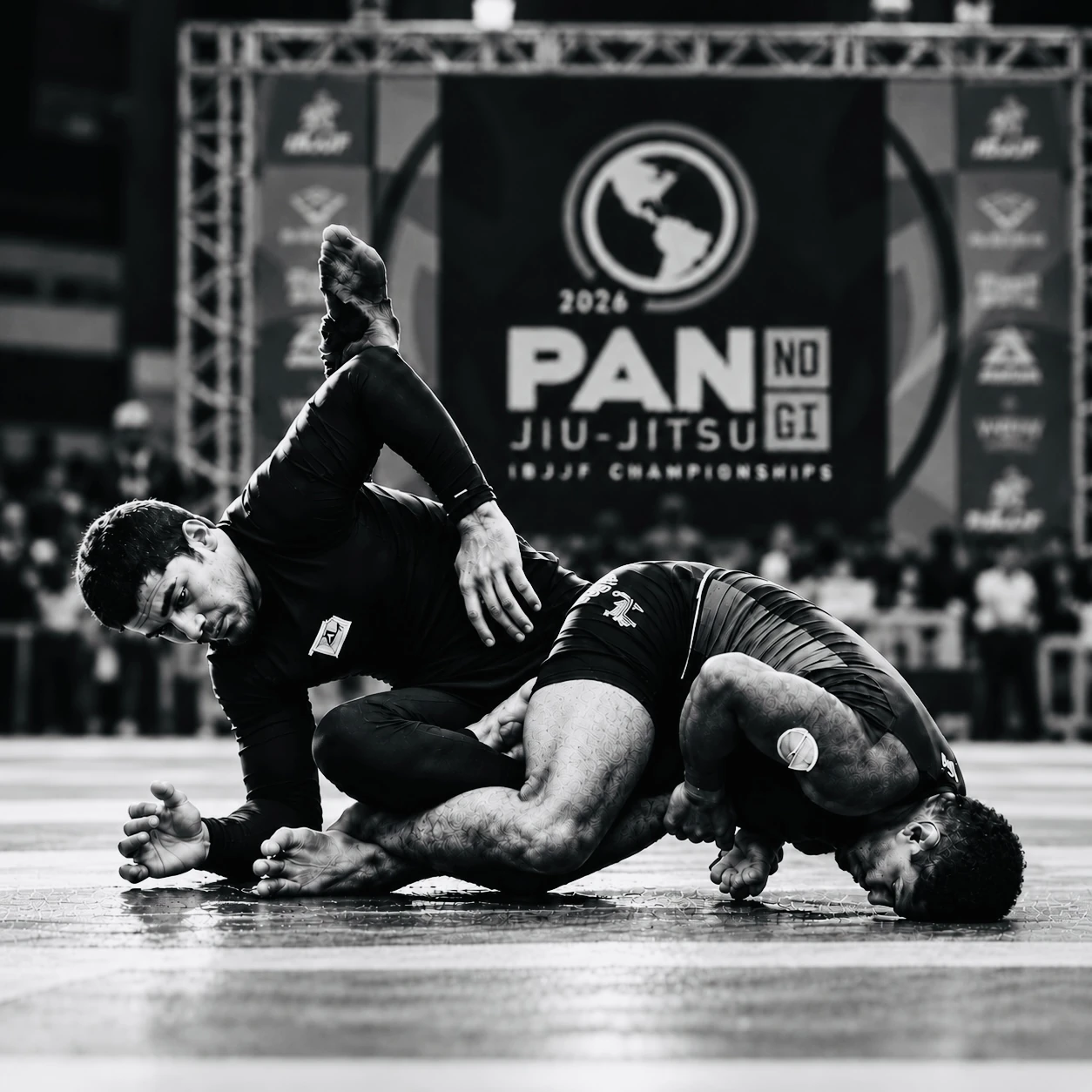
Helena Crevar needed approximately 20 seconds. Elijah Dorsey needed less than a minute. Paweł Jaworski needed seven victories—and left with two gold medals.
At the 2026 IBJJF No-Gi Pans, the championship moments came in different forms: a straight ankle lock answering a heel-hook attack, a violin armbar ending a loaded division, and a Polish champion following his historic ADCC breakthrough with another double. Even André Galvão’s silver carried a story, with the decorated veteran conceding gold to his own student.
Texas had its fingerprints across the weekend. Crevar brought another title back to her Austin training base. Austin Oranday ankle-locked his way into the heavyweight final. Competitors from Midland, Beaumont and Dallas added their own podium finishes.
They did it in New Jersey.
After four consecutive Texas editions from 2021 through 2024, No-Gi Pans moved to New York in 2025, then Secaucus this year. While elite athletes and coaches were helping establish Texas as America’s no-gi capital, one of the federation’s major championships headed elsewhere.
That matters beyond home-state pride. Texas offers major international airports, a central position within the continental United States and a compelling case as a practical gathering point for competitors across the Americas. For athletes funding their own careers, the cost of reaching a championship helps determine who gets to pursue it. The Northeast has its own strong grappling community, but Texas’s growing importance makes the departure worth questioning.
On October 2–4, more than 2,330 registered athletes gathered at the Meadowlands Exposition Center for the tournament’s 20th edition. Once the matches began, Jaworski supplied one of the clearest stories: a champion whose momentum kept accelerating.
Jaworski’s golden run keeps accelerating
Three weeks before No-Gi Pans, Paweł Jaworski became Poland’s first ADCC world champion, winning the under-88-kilogram division in front of a home crowd in Kraków. At 22, he arrived in New Jersey with that breakthrough still fresh—and left with two more gold medals.
His success was already sustained. Before Secaucus, Jaworski held the top spot in IBJJF’s no-gi rankings. His recent collection included weight-class gold at the 2025 Pans and World No-Gi Championships, double gold at the 2025 European No-Gi Championships, and another double at the 2026 Brasileiro No-Gi. Across that opening stretch of his black-belt career, he had accumulated fourteen IBJJF gold medals.
Seven victories in Secaucus added medium-heavyweight and absolute titles. They also kept his seasonal No-Gi Grand Slam pursuit alive, with European gold the remaining requirement after championships at Worlds, Brasileiro and Pans.
The results are imposing. The grappling explains why.
Jaworski’s guard makes opponents defend several threats at once. Protecting a leg can expose an arm or neck; committing to pressure can create an opening for a sweep. Against David Garmo in the medium-heavyweight final, that versatility mattered.
Garmo caught a guillotine as Jaworski attempted a single-leg. Jaworski escaped and worked from underneath. With Garmo accounting for the leg attacks, the finish came upstairs: a triangle.
Jaworski had reached the final by edging Luan Veras in a 6–6 quarterfinal decided by an advantage, then submitting Natan Chueng with an outside heel hook in the semifinal. Against Chueng, the lower-body threat produced the tap. Against Garmo, defending that threat left another opening.
The absolute final against Wallisson Oliveira Souza offered fewer opportunities. Jaworski swept, Oliveira Souza reversed, and neither established a decisive points lead. At 2–2, after Jaworski’s late sweep attempt failed to break the tie, the referee’s decision went to the Polish athlete.
Across seven bouts and two brackets, Jaworski could finish when the opening appeared and endure a close match when it did not.
His rise also reflects the work taking place at Academia Gorila. Marcin Polczyk launched its professional competition team in 2020, building a Warsaw training environment that now draws athletes from across Europe. Jaworski is its leading name, but teammate Martyna Kapuscinska added medium-heavyweight gold and absolute bronze in Secaucus, giving Gorila three adult black-belt championships.
Poland’s first ADCC champion had followed his historic breakthrough with an IBJJF double. For the rest of the field, the problem was becoming familiar: Jaworski kept arriving with more gold behind him—and finding ways to leave with more.
Sarah takes two. André gives one.
Sarah Galvão’s middleweight final against Nadia Frankland was still dangerous after the scoring was effectively settled.
Frankland stopped the opening double-leg, but Galvão followed with a single to score. Passing threats built Sarah’s advantage lead. Then Frankland landed a late takedown and attacked the arm, tying the points at 2–2 and forcing Galvão to defend her way through the finish.
The advantages held up. So did Sarah.
It was their second meeting of the tournament; Galvão had also beaten Frankland in the absolute semifinal. Against Maria Vitória Ruffatto-Gilpin for open-weight gold, she moved through back exposure and mount, then recovered the initiative after an escape. When one position slipped away, she found the next scoring opportunity.
Six victories delivered middleweight and absolute championships. Added to her lightweight and absolute titles at the gi Pans earlier in the year, they made four Pan golds across the two formats.
André Galvão’s super-heavyweight silver came with a more unusual ending.
After beating Jean Maltese and Sergio Vilas, both 2–0, he reached the final opposite his Atos student Natã Tenca. The teammates agreed to a closeout, choosing not to contest the championship match.
The concession went from teacher to student.
Rather than the younger athlete yielding to the established champion, André accepted silver and gave Tenca the top step. In a weekend defined by athletes fighting for gold, one of its most decorated competitors chose to pass it on.
Dorsey closes the show
Twenty-three athletes entered the men’s middleweight division. Tarik Hopstock held the top seed, with Marcelo Fausto, Kieran Kichuk, Max Hanson and Elijah Dorsey among the contenders.
Dorsey’s final three matches made an increasingly forceful statement.
First came a 2–0 quarterfinal win over Fausto. Then a 28–0 semifinal against Kichuk. Against Hopstock for gold, Dorsey dispensed with the need to build a score.
He pulled guard, threatened the shoulder, trapped the arm and brought his leg into position for the violin armbar.
The final lasted less than a minute.
A narrow win, a positional rout and a sudden submission carried Dorsey through three accomplished opponents. By the championship match, he had demonstrated how difficult it was to contain him in any phase.
Hopstock had reached the final by submitting Pedigo’s Max Hanson with an inside heel hook. Hanson, the 2024 champion and 2025 runner-up, took bronze after beating Logan Smith 4–2 in the quarterfinals.
Crevar needs 20 seconds
Sara Resetar attacked Helena Crevar’s heel almost immediately in the super-heavyweight final.
Crevar defended and countered with a straight ankle lock. Approximately 20 seconds after the start, the championship was hers.
There was no prolonged feeling-out process. Resetar committed to the leg, and Crevar found the winning answer inside the same exchange.
Training under John Danaher at Kingsway in Austin, Crevar added another major title to the state’s collection—and delivered one of the weekend’s quickest finals.
Emilio Hernandez’s featherweight championship required a longer escape from danger. Steven Gomez swept him and threatened an arm-triangle before Hernandez freed himself, sat up and caught a heel hook.
Gomez had put him in position to lose the match. Hernandez turned the escape into the opening that won it.
Oranday’s ankle locks carry him to silver
Austin Oranday brought a reliable weapon into the heavyweight bracket.
London Horn tapped to a straight ankle lock. So did Pedigo’s Bradley Schneider. Representing Alliance, Oranday took that finishing threat all the way to the final.
Wallisson Oliveira Souza made the championship match a different kind of test.
An underhook led to a rear body lock and a takedown. When Oranday returned to his feet, Oliveira Souza continued scoring there, repeatedly forcing the Texan back into pursuit. Oranday’s submission threat had carried him through the bracket; Oliveira Souza’s wrestling decided the final.
Oranday finished with silver, while Schneider and Joab de Oliveira Camara earned bronze.
The result followed an impressive December 2025 showing at the Dallas PGF qualifier, where Oranday’s finishes included a triangle, a straight ankle lock and Aoki locks. In Secaucus, the straight ankle lock again put him within reach of a championship.
His run also gave Southeast Texas a major result to claim. The Oranday family established its Port Neches academy in 2016, and its schools now serve the region, with Austin leading the Lumberton team.
Jett Thompson added adult black-belt absolute bronze for Texas-based Watkins Wrecking Crew. He beat Matheus Dias, Alehander Mariano and Natan Sap before Oliveira Souza stopped his run in the semifinal.
Pedigo finds gold beyond the familiar names
Pedigo’s adult black belts faced some unforgiving draws.
Hanson and Schneider reached the podium in middleweight and heavyweight. Jacob Couch beat Alex Hudic before losing to Joab de Oliveira Camara in the heavyweight quarterfinals. CJ Murdock won his opener before falling to Kichuk.
At purple belt, Bryan Lugo Cortes broke through for heavyweight gold. Four victories carried him to the title, with Jhonatan Motta his final opponent. Brycen Cook earned super-heavyweight silver, and Hudson Fletcher took ultra-heavyweight bronze.
The team finished ninth in adult men and seventh in masters. Three women supplied six of its masters championships: Kimberly Beckwith doubled at Master 3 blue-belt heavyweight and open class; Mina Daryoushfar at Master 4 blue-belt featherweight and open class; and Christine Brothwell at Master 4 black-belt middleweight and open class.
Dallas’s Jon Davis Pruett, who trains at Fortis MMA and competes under Ferreira BJJ, won Master 5 brown-belt featherweight gold.
Midland’s women make their mark
Bruno Bastos BJJ Midland finished fourth in the adult women’s team standings with 21 points, behind Atos, Gracie Barra and Team Lloyd Irvin.
Maya Youngblood won brown-belt roosterweight. Yasmin Cristhina Fonseca Silva took blue-belt middleweight gold and open-class silver. Their results helped place a West Texas academy among the tournament’s leading women’s programs.
Madison Marie Taggart brought adult purple-belt lightweight gold home to Beaumont’s Texas Punishment Crew. Deise Leonanjo Assonitis earned adult black-belt medium-heavyweight bronze for Double Five Highland Village.
The overall team championships went to AOJ in adult men, Atos in adult women, Gracie Barra in juveniles and Renzo Gracie in masters. But the weekend’s lasting moments were individual: Jaworski escaping a guillotine to find a triangle, Sarah Galvão defending through Frankland’s late attack, Dorsey finishing before the first minute, and Crevar answering a heel-hook threat before the match had time to settle.
IBJJF can move the mats. Texas keeps producing athletes worth putting on them. From Crevar’s championship to Oranday’s heavyweight run, from Midland’s women to the masters champions, Texas remained part of the championship’s competitive story. What the state lost was the opportunity to watch those performances at home—and to put more of its own athletes on the mats beside them.