By Saturday afternoon, Fargo is already erasing itself.
The thirty floor mats that carried thousands of matches throughout the week are disappearing one by one. Volunteers kneel at the edges, rolling vinyl into tight cylinders or folding sections onto themselves before carrying them toward the tunnels. With each mat removed, another patch of North Dakota State’s familiar green turf emerges. Hidden beneath nearly nine days of wrestling, the football field slowly reclaims the Fargodome.
By Saturday afternoon, only the two raised platforms remain. The Parade of All-Americans gives way to the Junior and 16U finals on adjacent stages beneath the lights.
The frantic rhythm that defined the previous eight days is gone with the floor mats. Coaches are no longer racing from one end of the building to the other. Wrestlers are no longer sprinting from staging to distant assignments. For the first time since Wednesday, nearly every eye inside the Fargodome is fixed on the same two circles.
The last matches. The last stop signs. The last champions. And perhaps the week’s most important story.
That story belongs to the women.
It was not always that way. For years, girls wrestling occupied the margins of the sport, fighting for mat space, tournament opportunities and recognition itself. Today, it closes America’s largest wrestling tournament—not as an exhibition or an afterthought, but in its final spotlight.
The green turf may be reclaiming the floor.
The spotlight is not.
The Division That Changed Wrestling
There was a time—not all that long ago—when girls wrestling existed almost entirely on borrowed opportunities: borrowed practice rooms, borrowed tournament brackets and borrowed respect.
That has changed.
High school programs have spread across the country. State championships have multiplied. Wrestling rooms that once celebrated having one female athlete now often carry complete lineups. The brackets are deeper, the technique is sharper and the expectations are higher.
At roughly the same time wrestling was forced to defend its place in the Olympic movement, women’s wrestling became one of the sport’s clearest arguments that it was expanding rather than retreating. It brought new athletes, new nations, new audiences and an entire generation that had no interest in being treated as an accessory to someone else’s tournament.
Every July, Fargo becomes the clearest measure of how far that generation has come.
The tournament is no longer introducing girls wrestling to the country. It is revealing the next generation of it.
Some of the athletes introduced on those stages Saturday afternoon will become college All-Americans. A smaller number will reach Senior World Teams. A select few may someday wrestle beneath the Olympic rings. Fargo guarantees none of that, but it offers the first serious glimpse.
The question is no longer whether girls wrestling belongs on the largest stage in the sport.
The final session answers that before the first whistle.
Pennsylvania Plants Its Flag
Every great wrestling state eventually develops a personality.
Iowa built its reputation on discipline. California overwhelms opponents with numbers. New Jersey produces technicians. Oklahoma still carries an unmistakable swagger.
Pennsylvania has become relentless.
Not because it occasionally produces a superstar, but because it rarely stops producing them. Wave after wave. Class after class. Year after year.
That depth overwhelmed both girls divisions in Fargo. Pennsylvania won the Junior championship with 165 points, surviving a one-point fight with Michigan. On the adjacent finals platform, during the same Saturday session, its 16U team completed the sweep with 172 points—59 more than second-place Oklahoma.
Two age divisions. Two team titles. One state standing above both fields.
Jaclyn Bouzakis, Emma Bacon and Marlee Solomon supplied Junior championships, but Pennsylvania’s team victory required far more than three stop signs. Finalists, consolation survivors and podium finishers accumulated points throughout the brackets until Michigan’s remarkable challenge finally ended one point short.
The 16U title made the state’s depth even clearer. Riley Karwowski won the championship at 110 pounds, but Pennsylvania did not need to dominate the top step at every weight. It flooded the remaining steps. Ashley Hoffman and Camilla Hathaway reached finals. Remington LaFlamme, Olivia Kearns, Brooklyn Henry and others kept appearing on podiums until the team race ceased to be a race at all.
Champions can tilt a tournament.
Depth takes possession of it.
Pennsylvania had both.
By the time the final whistles sounded, the Keystone State had done more than win two trophies. It had made the strongest argument of the weekend for being the center of girls wrestling in America.
One Point From a Different Story
Pennsylvania’s sweep can make the Junior race sound more comfortable than it was.
Michigan nearly stole it.
With 36 wrestlers entered—roughly half Pennsylvania’s number—Michigan scored 164 points and finished a single point behind the champions. Lillee Denson won at 100 pounds. Kaili Manuel won at 170. Mya Brandenburg, Maddie Hayden, Belicia Manuel and Alexis Lazar reached finals or placed near the top of their divisions, while other Michigan wrestlers kept collecting the smaller points that become enormous when the final margin is one.
There is no meaningful cushion in a one-point team victory. One additional takedown, one consolation match or one placement reversal could have changed the banner.
Pennsylvania left as champion.
Michigan left as proof that efficiency can nearly overwhelm volume.
Texas Was Two Different Teams
Texas finished fourth in the Junior standings.
It finished seventeenth in 16U.
Those results came from the same delegation, on the same floor, during the same tournament—and seemed to describe two entirely different states.
The Junior team was everywhere. Hailey Delgado reached the 120-pound final, Kailin Sebert made the championship match at 130 and Alyciana Rogers closed the lineup with a finals appearance at 235. Jordyn Parker wrestled back for third at 140, Jaida Kuntz placed seventh at 190 and Noah Kovach added an eighth-place finish at 100.
Riley Drennan also became an All-American at 130, but an injury ended her tournament with a medical forfeit in the seventh-place match. The eighth beside her name records the placement. It does not explain how her week ended.
Texas scored 84 points, trailing only Pennsylvania, Michigan and Indiana. That is not a poor performance. It is also not the tournament Texas came north imagining.
Three finalists stood one victory from red stop signs. Delgado met Pennsylvania’s Marlee Solomon while the Keystone State was squeezing every available point from its one-point team race. Sebert faced Wisconsin’s Madilyn Peach. Rogers drew Indiana’s Aubrey Bartkowiak in the heavyweight final.
All three Texans had survived the portion of Fargo that removes most of the field before anyone begins arranging the championship stage. They had navigated crowded brackets, short recovery windows and opponents carrying state titles and national résumés of their own.
Then all three finals went the other way.
Second place in Fargo is a national achievement accompanied by the immediate knowledge that first place had been standing directly across from you. The medal arrives. The photographs are taken. Then the red stop sign leaves in someone else’s hands.
Texas had three opportunities to change the language surrounding its tournament. It converted none of them.
The depth extended beyond the placers. Marisa Iturrino, a Creekview High School standout, former folkstyle national champion and U17 Pan American bronze medalist for Puerto Rico, also went without a podium finish. Lucy Clarno arrived as a multi-time Texas champion and a UIL Class 6A state champion, a title she earned as a freshman in one of the country’s deepest high school classifications.
Texas was also without Landri Von Gonten, the 2025 16U Fargo champion and reigning UIL Class 6A state champion, who was preparing to represent the United States at the U17 World Championships in Baku. Her absence added another layer to a Junior performance that was already strong enough to finish fourth, yet still felt short of its full ceiling.
The talent was there from top to bottom.
So was the difficulty.
Fourth place demonstrated quality. Three finalists demonstrated championship potential. But Fargo does not grade on potential, and the Junior team came close enough to make fourth feel both impressive and unfinished.
The 16U result was harder to explain.
Too Much Talent for Seventeenth
Texas finished seventeenth in the 16U standings with 36 points.
The number looks ordinary until the roster is considered. Then it becomes one of the strangest results of the tournament.
This was not an inexperienced group making its first trip north. In several respects, the 16U delegation carried a deeper résumé—and perhaps a higher collective ceiling—than the Junior team that finished fourth.
Zaylyn Woods entered Fargo as the reigning 16U folkstyle national champion after years of winning national events across multiple age divisions. She was not merely a contender; to many familiar with the bracket, she was one of the favorites.
Vivienne Yarbrough and Sage Mosier had been competing nationally since childhood, accumulating years of state titles and high-level tournament experience. Audrey Cunningham arrived as the Texas freestyle and Greco-Roman champion and ultimately became the state’s lone 16U finalist.
Cameron Hodge had already placed at Fargo, finished second at Women’s Nationals and entered as a Texas champion in both international styles. Tiana Crawford brought a 2026 NHSCA All-American finish, a Southern Plains title and a Texas freestyle championship.
Kyla Janowitz carried Texas and Southern Plains placements across both styles. Avery Fitzgerald had already stood on a Fargo podium and returned as a Texas freestyle champion, while Madison Fitzgerald also entered as a state champion.
Kylie Keach had already won two USA Wrestling state titles, placed at Southern Plains and captured a UIL district championship as a freshman. She also brought extensive experience from submission grappling, including multiple ADCC titles.
Taken individually, those résumés suggested several legitimate All-American candidates. Taken collectively, they suggested far more.
Many members of this generation had already succeeded together. Texas won the middle school division at Heartland in 2024 and finished second in 2025. Nearly all of the Fargo entrants had competed on either the 2025 14U or 2026 16U Women’s National Duals teams, which finished seventh and fourth in the freestyle Gold Pool.
The team placements were impressive. The individual matchups were more revealing.
Members of this same group had already defeated opponents from Pennsylvania, California, Ohio, Washington, Wisconsin and other established powers. Several ran through their dual assignments against wrestlers representing states that would later finish far ahead of Texas in Fargo.
That history matters because it removes the easiest explanation.
Texas did not finish seventeenth because its wrestlers were incapable of beating the athletes who finished above them. Many had already done it.
Dual tournaments and individual brackets reward different things. Fargo adds enormous fields, difficult draws, short recovery windows and the possibility that one bad six-minute stretch ends a championship run. But those prior head-to-head results still made the expectations reasonable.
Inside Texas, the prevailing belief was that this group might bring home more Fargo hardware than any 16U girls delegation before it.
Instead, Cunningham finished second, Woods placed fifth and Hodge finished sixth.
Then the medals stopped.
Thirty-six points. Seventeenth place. A roster built to make noise left behind a result that landed with a thud.
There are ordinary explanations available. Fargo is brutal. Injuries, illness, weight management, nerves and difficult draws can alter an entire tournament.
No single result proves a failure of leadership, and no responsible account can assign blame without access to the preparation plans, corner assignments and decisions made throughout the week.
But there was too much established ability here to dismiss the result as random tournament weather.
The harder question is whether one of the country’s deepest age-group rosters ever became a coherent team.
Texas is vast. Its best wrestlers are scattered across regions, clubs and coaching systems separated by hundreds of miles. They may wear the same singlet in July without sharing much preparation or many trusted coaching relationships throughout the year.
That does not make cohesion impossible. It makes cohesion something that must be deliberately built.
The Texas 16U girls did not lack talent. Their résumés—and their victories over wrestlers from the states above them—settle that question.
Whether the structure around them converted that talent as effectively as it could have is a question Texas should be willing to ask.
The Stop Signs Scatter
Pennsylvania owned the team trophies, but Saturday’s most memorable stop signs did not all travel toward wrestling’s traditional centers of power.
Some went somewhere entirely new.
At 155 pounds, Eloise Woolsey entered the Junior final carrying more than her own championship ambition. No wrestler from New Mexico had ever won a Fargo title. Woolsey had already beaten Connecticut standout Sarah Henckel in the semifinal. In the final, she defeated New Jersey’s Ella Poalillo and became the first Fargo champion in New Mexico history. Then came the second honor: Outstanding Wrestler.
There are championships that confirm a program’s reputation and championships that create one.
Woolsey’s did the latter.
On the adjacent 16U stage, Kansas was conducting a different kind of raid. Gray Joyce won at 145 pounds, Siobhan Flanner took 170 and Kaylee Thompson completed the run at 190.
Three stop signs. Three upper weights. One state announcing that its third-place team finish was built on more than accumulated depth.
Kansas nearly made it four. Presley Beard reached the 125-pound final before Washington’s Winter West stopped the bid. Even without the fourth, Kansas produced one of the defining performances of the championship session. Pennsylvania won the team title, and Oklahoma finished second, but no state carried away more 16U champions than Kansas.
Elsewhere, the brackets refused to honor reputation. Woods entered 130 as one of the division’s most recognizable wrestlers and a favorite in the eyes of many who knew the field. Anastasia Rodnikova erased that expectation by one point in the semifinal before Oklahoma’s Rachel Garcia defeated Rodnikova for the championship.
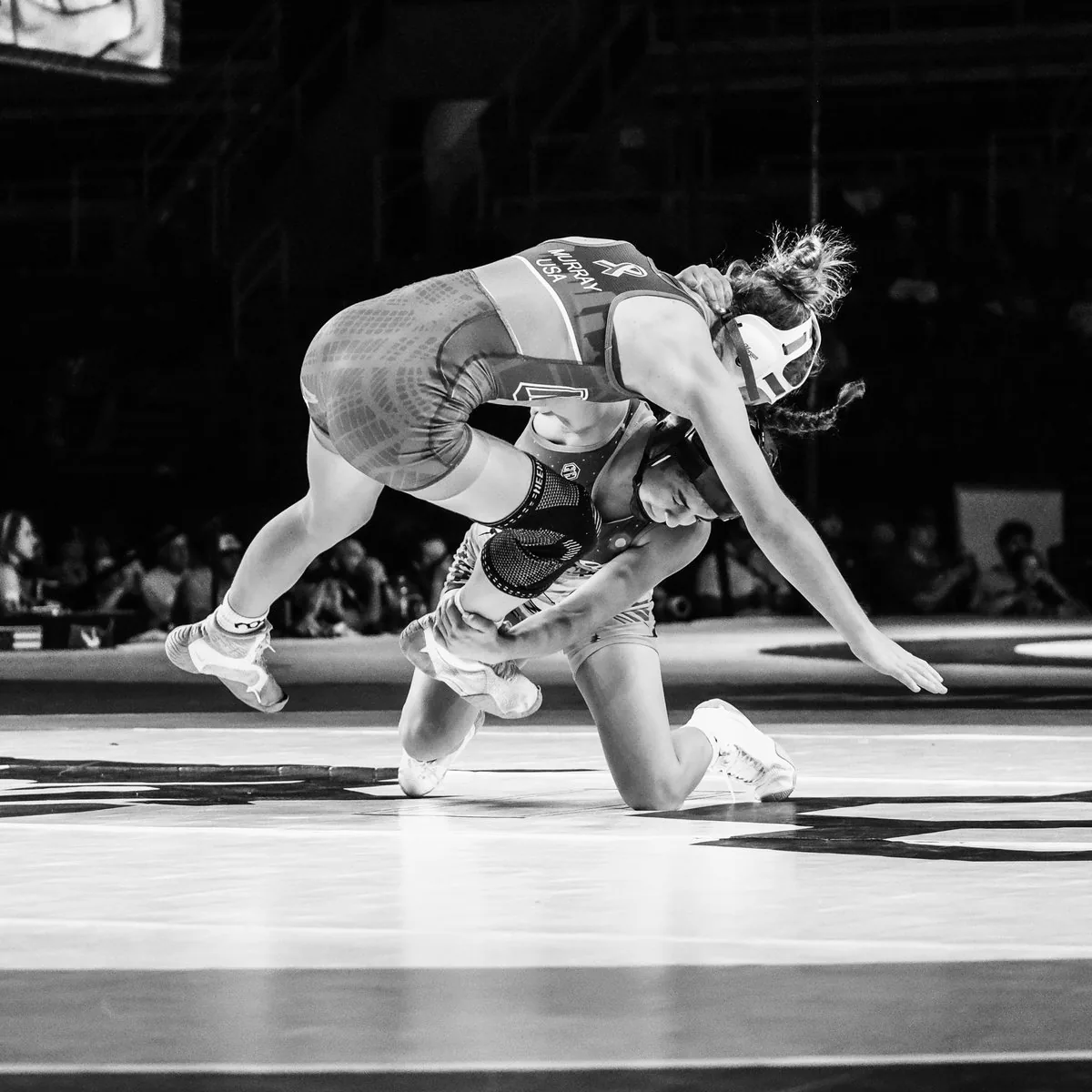
Maisie Elliott arrived with a U17 World bronze medal and did not reach the 100-pound final. Sophia Valdez came to Fargo as a U17 World Team member, only for Massachusetts’ Brooklyn Murray to defeat her by a point for the 95-pound title.
That is the danger hidden inside the word favorite.
It describes everything that happened before Fargo.
Fargo cares only what happens after the whistle.
The championships scattered across New Jersey, Michigan, Virginia, Florida, Pennsylvania, Ohio, Wisconsin, Indiana, Minnesota, Illinois, Iowa, Arizona, Oklahoma, Washington, Maryland, Kansas, New York, Massachusetts, California—and, for the first time, New Mexico.
The list alone misses the point.
The point was New Mexico winning for the first time. Kansas winning three times. World-level credentials failing to guarantee a place in the final. Established names falling before less familiar ones.
Team depth won the banners.
Individual brilliance—and occasional chaos—decided where the stop signs went.
That is why Fargo remains Fargo. The map matters. The résumé matters.
Until suddenly, for six minutes, neither one does.
The Younger Stage Was Not the Undercard
The phrase “16U” can make the division sound preparatory—something before the real thing, a developmental bracket populated by athletes who will matter later.
That description did not survive contact with the finals.
The 16U wrestlers did not compete like girls waiting for their turn. They wrestled with the pace, technique and composure of athletes already accustomed to national pressure. Some had been traveling since elementary school. Others had won major national titles or beaten established names at duals and regional tournaments before arriving in Fargo.
By Saturday, recognition was no longer optional.
The champions came from across the map: Brooklyn Murray of Massachusetts, Abigail Peterson of Iowa, Bella Manno of Arizona, Riley Karwowski of Pennsylvania, Kaylee Vera of Ohio, McKenna Wilson and Rachel Garcia of Oklahoma, Winter West of Washington, Rain Scott of Illinois, Kesi Tsarni of Maryland, the Kansas trio of Joyce, Flanner and Thompson, Ava Guilmette of New York, Lyla Hensen of Michigan and Taya Maumausolo Matagi of California.
Many still have years before college, yet they already move through ties, transitions and exposure sequences with a sophistication that would have been unusual in high school girls wrestling not long ago. The improvement is visible in the speed of the hand fights, the confidence in scrambles and the refusal to concede positions that once became automatic scores.
The technical gap between the best Junior and 16U wrestlers is narrowing because many of the younger athletes have been trained seriously from the beginning. They were not introduced to girls wrestling as a novelty. They entered established rooms, followed national schedules and grew up expecting Fargo to be part of the plan.
The division does not need to be sold as promising.
It is already dangerous.
The College Question Waiting Outside the Dome
The high school growth is impossible to miss.
The collegiate destination remains less complete.
More schools now sponsor women’s wrestling, and the first NCAA championship has finally placed the sport under the organization’s full championship umbrella. Yet most of the collegiate expansion has occurred outside Division I, and opportunities remain unevenly distributed compared with the number of accomplished girls now emerging from high school programs.
Pennsylvania presents the contradiction most clearly.
The state has women’s college wrestling. It has programs competing at the Division II and Division III levels, and additional schools are joining them. What it did not have at the time of this Fargo tournament was an established Division I women’s team competing at the level its extraordinary girls pipeline would seem capable of supporting.
That distinction matters.
Pennsylvania won both Fargo divisions. It produced champions, finalists and scorers across the entire weight range. It may now possess the strongest girls developmental system in the country, yet many of its most accomplished wrestlers must still leave the state if they want a Division I destination.
The question need not become a sermon. The results make the point quietly enough.
If Pennsylvania can build the deepest girls wrestling state in America, why has one of its flagship Division I institutions not built a program to meet it?
The same tension extends beyond Pennsylvania. High school participation and talent have grown faster than the infrastructure above them. The wrestlers are arriving before the sport has finished building enough places for them to go.
Fargo celebrates the pipeline.
It also reveals where the pipe narrows.
What Fargo Revealed
The team trophies told one story.
The brackets told several others.
Pennsylvania established itself as the country’s standard by winning both age divisions. Michigan came within one point of taking the Junior title. Kansas turned three 16U champions into one of the loudest individual performances of the weekend. New Mexico produced its first Fargo champion.
Texas showed enough Junior depth to finish fourth and enough 16U talent to make seventeenth nearly impossible to reconcile.
The stars did not always win. The favorites did not always reach Saturday. The résumés mattered until they did not.
That is the difference between a national tournament and a national reckoning.
Fargo does not ask who was supposed to win.
It records who did.
Five Takeaways
Winning either team title would have been significant. Winning both placed Pennsylvania alone at the center of the national conversation. The Junior team survived Michigan by one point; the 16U team overwhelmed the field through depth at nearly every weight.
Michigan scored 164 points with only 36 entries and came within one point of the championship. Its performance was one of the most efficient and consequential of the tournament.
Fourth place, seven All-Americans and three finalists represented one of the best team performances in the field. The absence of a champion kept it from feeling complete.
This was not an ordinary roster producing an ordinary result. Its wrestlers had already won state, regional and national events and had beaten opponents from many of the states that finished above Texas. Seventeenth cannot be explained by a lack of ability.
Woolsey delivered New Mexico’s first Fargo championship. Kansas crowned three 16U champions. Both performances demonstrated that the sport’s national power is spreading beyond its most familiar centers.
By the Numbers
2 — Pennsylvania team championships
1 — Point separating Pennsylvania and Michigan in the Junior race
59 — Points separating Pennsylvania and Oklahoma in 16U
3 — Texas Junior finalists
0 — Texas champions across the two girls divisions
4th — Texas’ Junior team finish
17th — Texas’ 16U team finish
3 — Kansas 16U champions
1st — Fargo championship in New Mexico history
2 — Finals stages operating side by side
30 — Floor mats disappearing before the championship session
The Last Whistle
By the end, most of Fargo was already gone.
The thirty floor mats had been rolled or folded and carried toward the tunnels. The green NDSU turf had reclaimed the building one rectangle at a time. Only the two raised stages remained, the entire girls wrestling season compressed into two circles beneath the lights.
Then the final matches ended.
Hands were raised, stop signs were lifted and photographs were taken. The champions walked away from the stages and disappeared into the same concourses as everyone else.
Soon, the platforms would go too. The banners would come down. Teams would scatter toward airports, hotel parking lots and highways stretching in every direction away from North Dakota.
Some of these girls will become college champions. A few will make World Teams. One or two may someday wrestle for Olympic gold. Others will leave the sport before anyone expects them to.
That is the bargain.
Fargo reveals the future without promising it.
But Saturday afternoon made one thing clear: women’s wrestling no longer arrives at the end of the tournament merely because someone placed it there on the schedule. It arrives at the end because it has become the only possible closing act.
The final medals belong to them. The final stop signs belong to them.
The last whistle belongs to them.
By then, Fargo has nearly erased itself.
The story remains.