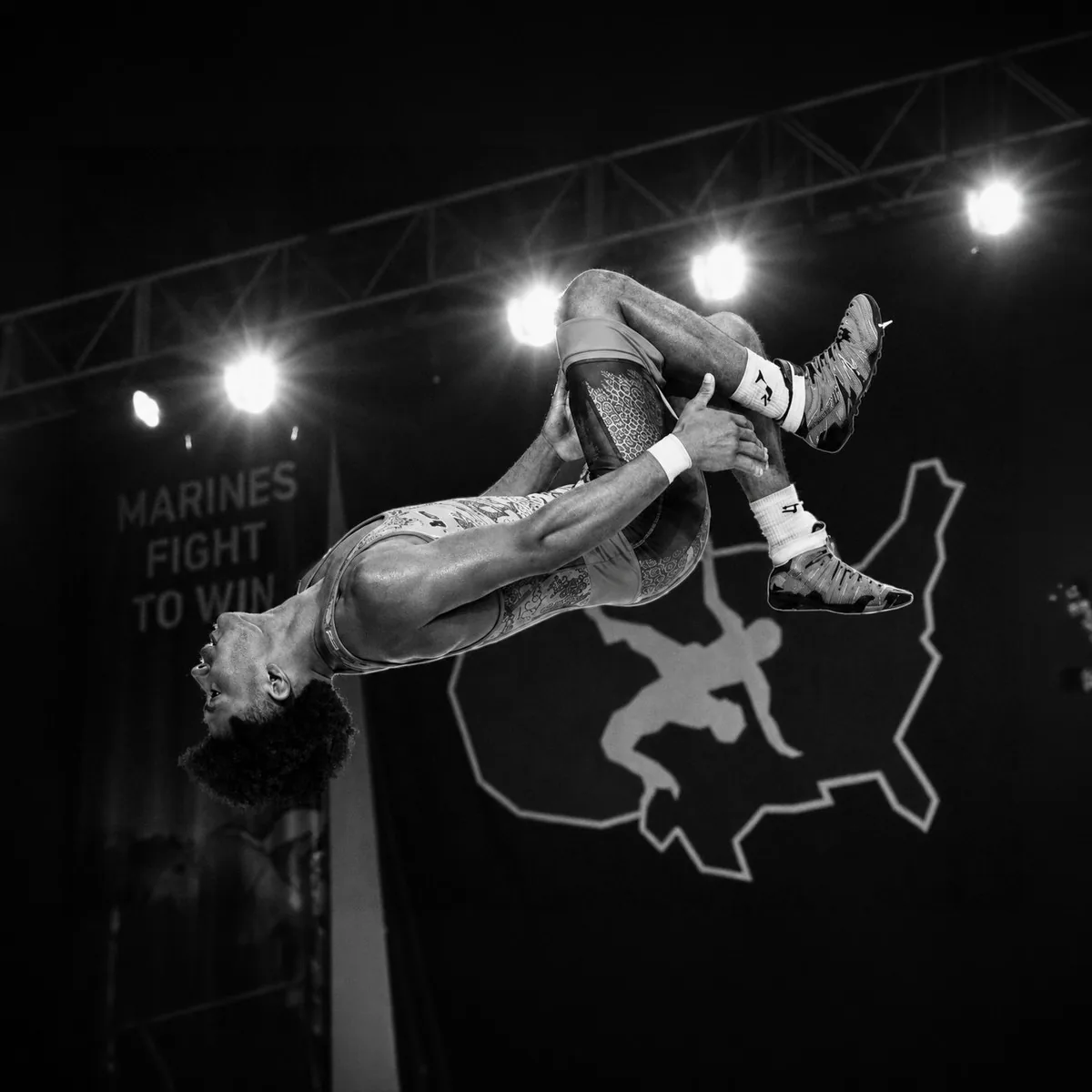
For nine days every July, Fargo becomes the center of the American wrestling universe.
The FARGODOME barely sleeps.
Before sunrise, coaches move through the concrete concourses carrying coffee, credentials and bracket sheets. By midmorning, whistles overlap across a floor covered in mats. Thousands of wrestlers arrive believing they can win. Most discover how quickly Fargo can separate belief from reality.
As the tournament advances, the field contracts. The crowds lean closer. Every exchange begins carrying the weight of an entire season.
Eventually, only the finalists remain.
They walk onto a raised stage beneath the brightest lights in the building, wrestling for a trophy unlike any other in American sports: a red octagonal plaque modeled after a stop sign.
It is not subtle.
Neither is Fargo.
The 2026 U.S. Marine Corps Junior Nationals men’s freestyle tournament crowned 32 champions across the Junior and 16U divisions, but the two team races told very different stories.
California captured the Junior championship with a balanced lineup and three individual champions. Pennsylvania did considerably more than win 16U, setting a new team-scoring record while nearly doubling the total of its nearest challenger.
One state ruled the present.
The other offered a warning about the future.
California Takes Control of the Junior Division
California entered the Junior tournament with 78 wrestlers and left with 197 team points, three individual champions and the team championship.
The Golden State finished 39 points ahead of Iowa, which narrowly edged Pennsylvania for second, 158–157. Florida placed fourth with 119 points, followed by Illinois with 105.
California’s title was not the product of one overwhelming individual performance. It was constructed across the brackets through depth, advancement points and wrestlers who continued scoring after their championship hopes had ended.
Luke Loren captured the title at 106 pounds. Two-time U17 World champion Samuel Sanchez controlled the 126-pound tournament and defeated Iowa’s Hayden Schwab by an 11–1 technical fall in the final. Jesse Grajeda added the third championship at 144, shutting out Indiana’s Braylon Reynolds, 11–0.
California also sent Mario Carini and Daniel Moylan into the finals at 175 and 215 pounds, respectively. Both came within a point of giving the state two more champions.
Carini fell to Ohio’s Zack Aquila, 9–8. Moylan lost an 11–10 decision to Indiana’s Sam Howard.
Those defeats did not erase their value to the team race. They helped illustrate why California won it.
Fargo team championships are rarely secured by champions alone.
They are won by the wrestlers who keep advancing after a setback, turn consolation matches into points and give a state production throughout the lineup.
California did that better than anyone in the Junior field.
| Place | State | Points |
|---|---|---|
| 1 | California | 197 |
| 2 | Iowa | 158 |
| 3 | Pennsylvania | 157 |
| 4 | Florida | 119 |
| 5 | Illinois | 105 |
| 6 | Indiana | 98 |
| 7 | Ohio | 92 |
| 8 | Minnesota | 91 |
| 9 | Wisconsin | 68 |
| 10 | Oklahoma | 53 |
Miller Makes It Three
There are Fargo champions, and then there are wrestlers whose names become part of Fargo history.
Pennsylvania’s Melvin Miller joined the latter group at 165 pounds.
Miller defeated Illinois’ Rocco Cassioppi, 7–4, to claim his third Junior men’s freestyle championship. Winning one Fargo title can define a high school career. Winning three places Miller in rare company and reinforces his standing as one of the premier wrestlers of his generation.
His championship was one of only two won by Pennsylvania in the Junior division, but both carried weight.
At 120 pounds, Brayden Wenrich overwhelmed New Jersey’s Michael Batista, 14–2, in the final. The title helped Pennsylvania finish one point behind Iowa in a team race where every consolation victory and placement match mattered.
Woode Leaves With More Than a Stop Sign
Hawaii brought only nine wrestlers into the Junior team standings.
One of them became the tournament’s Outstanding Wrestler.
Analu Woode completed his 113-pound run by pinning California finalist Thales Silva in 3:15. Woode’s championship gave Hawaii 25 team points and a 14th-place finish despite having one of the smallest delegations in the field.
That is part of Fargo’s appeal.
Large state programs arrive with the depth to chase team trophies. Individual wrestlers arrive from everywhere else with the ability to disrupt brackets, defeat nationally recognized opponents and leave North Dakota carrying the same stop sign.
For one tournament, geography offers no protection.
Familiar Names, New Chapters
Georgia’s Antonio Mills successfully defended his Fargo championship, moving up from the weight where he won in 2025 and defeating New Jersey’s Paul Kenny, 12–9, at 132 pounds.
Florida produced three champions: Tyler DeKraker at 138, Charlie DeSena at 157 and Michael Mocco at 285.
Mocco’s heavyweight final delivered one of the session’s late swings. He used a four-point action to defeat Wisconsin’s Tyson Martin, 9–6, and claim his second Fargo championship—and his first in the Junior division.
Minnesota’s Davis Parrow survived a difficult 150-pound bracket and defeated Pennsylvania’s Jason Dube, 9–7. Iowa’s Waylon Cressell controlled the 190-pound final against Pennsylvania’s Nicholas Singer, 8–3.
Several of the closest finals belonged to wrestlers who refused to concede the decisive exchange.
DeSena edged Iowa’s Mac Crosson, 3–2. Aquila escaped Carini by one point. Howard survived Moylan by the same margin.
Fargo does not require a champion to dominate every match.
It requires him to win the next one.
| Weight | Champion | State | Championship result |
|---|---|---|---|
| 100 | Ty Martin | Iowa | Def. Symon Woods, 10–0 |
| 106 | Luke Loren | California | Def. Cache Williams, 12–8 |
| 113 | Analu Woode | Hawaii | Def. Thales Silva, fall 3:15 |
| 120 | Brayden Wenrich | Pennsylvania | Def. Michael Batista, 14–2 |
| 126 | Samuel Sanchez | California | Def. Hayden Schwab, 11–1 |
| 132 | Antonio Mills | Georgia | Def. Paul Kenny, 12–9 |
| 138 | Tyler DeKraker | Florida | Def. Dawson Youngblut, 10–2 |
| 144 | Jesse Grajeda | California | Def. Braylon Reynolds, 11–0 |
| 150 | Davis Parrow | Minnesota | Def. Jason Dube, 9–7 |
| 157 | Charlie DeSena | Florida | Def. Mac Crosson, 3–2 |
| 165 | Melvin Miller | Pennsylvania | Def. Rocco Cassioppi, 7–4 |
| 175 | Zack Aquila | Ohio | Def. Mario Carini, 9–8 |
| 190 | Waylon Cressell | Iowa | Def. Nicholas Singer, 8–3 |
| 215 | Sam Howard | Indiana | Def. Daniel Moylan, 11–10 |
| 285 | Michael Mocco | Florida | Def. Tyson Martin, 9–6 |
Pennsylvania Does Not Merely Win 16U
California ruled the Junior division.
Pennsylvania overwhelmed the 16U field.
The Keystone State scored 352 points, setting a new tournament team record and finishing 174 points ahead of runner-up Iowa. California was third with 128, followed by Ohio at 115 and Wisconsin at 100.
Pennsylvania’s total was nearly equal to the combined scores of Iowa and California.
It was also the state’s eighth consecutive 16U men’s freestyle team championship, extending a run of control that has become one of Fargo’s defining dynasties.
The scale of the victory was particularly striking because Pennsylvania did not simply collect championships at a few weights and disappear elsewhere.
It filled the podium.
The state produced finalists and All-Americans throughout the lineup, repeatedly placing multiple wrestlers inside the same weight class. At 132 pounds, Pennsylvania supplied both finalists and three of the four semifinalists.
Alex Marchetti defeated teammate CJ Caines, 5–1, to win the division and was named the 16U Outstanding Wrestler. Marchetti’s championship came at the center of Pennsylvania’s deepest bracket and made him the clearest individual symbol of a team performance built on waves of scorers.
Reece Movahed won another championship for Pennsylvania at 144 pounds, shutting out Texas finalist Vinny Ferrari, 4–0. Layden Acevedo added a title at 175 with an 11–0 technical fall over Minnesota’s Destan Skelly. Bryce Collins won at 190, defeating Washington’s Duane Leslie, 6–2.
But the record was not built solely by the four champions.
It came from volume.
Pennsylvania entered 108 wrestlers in the filtered team standings and continued accumulating points through medal matches across the tournament. Its 352-point total did not leave a competitive team race behind it.
It left a gap.
| Place | State | Points |
|---|---|---|
| 1 | Pennsylvania | 352 |
| 2 | Iowa | 178 |
| 3 | California | 128 |
| 4 | Ohio | 115 |
| 5 | Wisconsin | 100 |
| 6 | Indiana | 88 |
| 7 | Minnesota | 79 |
| 8 | Washington | 76 |
| 9 | Illinois | 71 |
| 10 | Florida | 58 |
Iowa Owns the Lightweights
Pennsylvania controlled the overall standings, but Iowa dominated the opening stretch of the finals.
Kai McDonald captured the 88-pound championship with a 10–0 technical fall over Pennsylvania’s Grayden Paris. Johnathan Thompson followed with a 13–2 victory at 94. At 100 pounds, Cyrus Millage completed Iowa’s run of three consecutive champions by defeating Pennsylvania’s Nelson Villafane, 10–8.
The three titles helped Iowa score 178 points and finish a clear second in the team race.
Iowa added a fourth championship at 157 when Jaimon Mogard defeated Ohio’s Tommy Rowlands, 4–1.
California answered with consecutive champions of its own.
Sebastian Gutierrez defeated teammate Cameron Bartlow, 6–5, in the 106-pound final. Michael Bernabe followed with a criteria victory over Iowa’s Diego Robertty at 113.
The opening seven finals produced six champions from Iowa or California before Ohio’s Cohen Reer and Indiana’s Jeremy Carver interrupted the run at 120 and 126.
New Champions Across the Board
The 2026 16U tournament produced an entirely new group of champions.
Cohen Reer upset top-seeded Spencer McCammon, 13–5, at 120 pounds. Jeremy Carver used a late four-point action to secure the 126-pound title over Arizona’s Kash Larkin, 8–4.
Oklahoma’s Bryar Hooks defeated Washington’s Austin Schield, 5–3, at 138.
Florida’s Illia Kyrianenko survived Virginia’s Reza Massjouni, 8–6, in the 150-pound final.
Georgia’s Harrison Murdock delivered one of the most dominant championship performances, earning a 10–0 technical fall over Wisconsin’s Easton Kammerud at 165.
Wisconsin closed strongly in the upper weights. Kade Splinter won the 215-pound championship by technical fall, and Minnesota’s Sawyer Schendel ended the division by defeating Wisconsin’s Leland Havens, 6–3, at 285.
The names will change as the athletes grow into new divisions and heavier weights.
The pattern will not.
Many of the Junior champions celebrated this week first appeared on Fargo’s national radar in the 16U tournament. The athletes who stood atop these podiums will return older, stronger and more recognizable.
Fargo has always introduced the future before the rest of the country learns its name.
| Weight | Champion | State | Championship result |
|---|---|---|---|
| 88 | Kai McDonald | Iowa | Def. Grayden Paris, 10–0 |
| 94 | Johnathan Thompson | Iowa | Def. Jaxon Holtz, 13–2 |
| 100 | Cyrus Millage | Iowa | Def. Nelson Villafane, 10–8 |
| 106 | Sebastian Gutierrez | California | Def. Cameron Bartlow, 6–5 |
| 113 | Michael Bernabe | California | Def. Diego Robertty, 4–4 |
| 120 | Cohen Reer | Ohio | Def. Spencer McCammon, 13–5 |
| 126 | Jeremy Carver | Indiana | Def. Kash Larkin, 8–4 |
| 132 | Alex Marchetti | Pennsylvania | Def. CJ Caines, 5–1 |
| 138 | Bryar Hooks | Oklahoma | Def. Austin Schield, 5–3 |
| 144 | Reece Movahed | Pennsylvania | Def. Vinny Ferrari, 4–0 |
| 150 | Illia Kyrianenko | Florida | Def. Reza Massjouni, 8–6 |
| 157 | Jaimon Mogard | Iowa | Def. Tommy Rowlands, 4–1 |
| 165 | Harrison Murdock | Georgia | Def. Easton Kammerud, 10–0 |
| 175 | Layden Acevedo | Pennsylvania | Def. Destan Skelly, 11–0 |
| 190 | Bryce Collins | Pennsylvania | Def. Duane Leslie, 6–2 |
| 215 | Kade Splinter | Wisconsin | Def. Mason Chamberlain, 10–0 |
| 285 | Sawyer Schendel | Minnesota | Def. Leland Havens, 6–3 |
Five Takeaways From Men’s Freestyle
Its three champions attracted the attention, but the Golden State’s broader lineup won the team title. California put wrestlers into five finals and scored enough across the placement rounds to create meaningful separation from Iowa and Pennsylvania.
Eight consecutive team championships would already constitute a dynasty. A record 352-point performance suggests the gap may be growing rather than closing.
One championship earns a stop sign. Three place a wrestler into a much smaller historical category.
Junior champions represented nine states. The 16U champions came from 10. California and Pennsylvania won the team trophies, but neither state controlled every podium.
Rankings create expectations. Fargo tests them against enormous brackets, unfamiliar opponents and the accumulating physical toll of a tournament where there is rarely an easy round.
By the Numbers
32 individual champions across the two men’s freestyle divisions.
197 points for Junior champion California.
352 points for 16U champion Pennsylvania.
39 points separated California from second-place Iowa in the Junior race.
174 points separated Pennsylvania from Iowa in 16U.
Eight consecutive 16U team championships for Pennsylvania.
Three Junior freestyle titles for Melvin Miller.
Nine days of competition inside the FARGODOME, from July 10–18.
One red stop sign every wrestler came to Fargo hoping to carry home.
The Road Out of Fargo
When the last men’s freestyle medal was awarded, the wrestlers left the raised stage in different directions.
Some carried stop signs.
Some carried medals.
Most carried the memory of the match that ended their run.
California left with the Junior team championship and proof that no state assembled a better group of established high school freestyle wrestlers.
Pennsylvania left with a record, an eighth consecutive 16U title and evidence that the next wave may be even deeper than the one already competing above it.
Somewhere between those two performances lies the present and future of American wrestling.
Both passed through Fargo.
And both left the rest of the country with work to do.