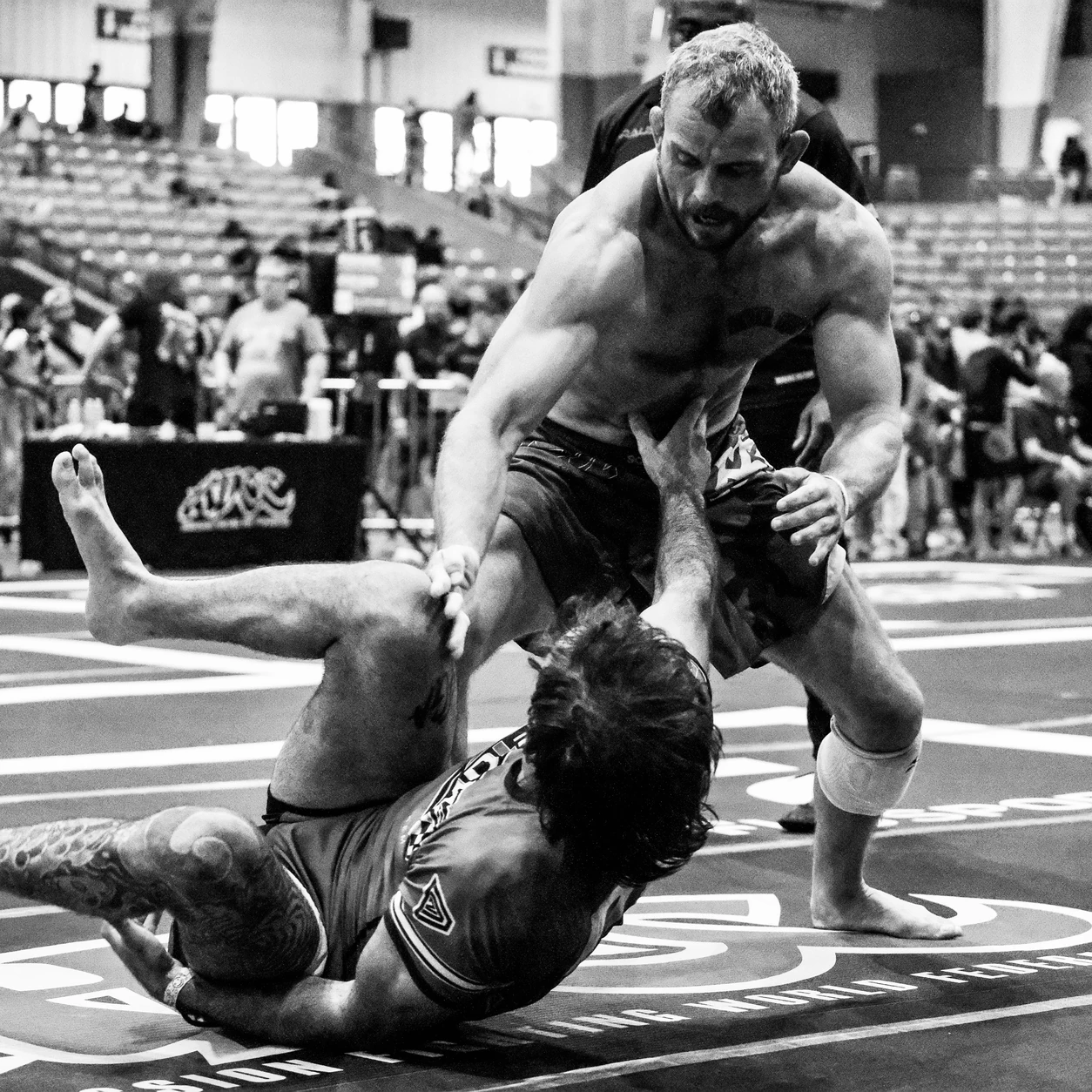
Nashville apparently had no intention of being the quiet weekend after Worlds.
The ADCC Open rolled into a rodeo arena in Franklin on September 19 with serious competitors and very little interest in winding down the season. Williamson County AG Expo Park gave it the right setting: country, practical and unmistakably Middle American. Like Luedecke in Austin, it was a building accustomed to a rougher sort of entertainment. For this particular Saturday, the grapplers supplied it.
Some of the fighting escaped the brackets. Multiple brawls broke out over the course of the event. Nobody needed that addition to a day already full of people trying to take one another down, but Nashville was hardly suffering from a shortage of intensity. The matches were worth the attention on their own.
The timing helped. The adults had just watched the world championship unfold in Poland. The younger athletes were still close enough to August’s Youth Worlds to remember precisely how they felt about their own place in that picture. Some had medals. Some had unfinished business. Others had spent the championship on the outside of the invitation list, waiting for another opportunity to make their case.
In Nashville, they could stop waiting.
Jacob Couch and Abraham La Montagne gave the adult competition a final with real weight behind the names. Couch brought Pedigo’s hard-earned reputation into the advanced −91 kg bracket. La Montagne beat him on points, then added the absolute title with a submission over Daniel Ribeiro. Two golds, two different tests, and a win over Couch at the center of it.
That is the attraction of a good Open. An established competitor shows up, and everybody else gets a chance to make his afternoon difficult. There is no need to wait for a promoter to decide that a matchup is marketable. Win enough matches and the opportunity is standing in front of you.
Troy Mercer’s Masters 1 −83 kg semifinal supplied a different kind of fireworks—the kind that makes you question what, exactly, the officials were watching.
Mercer drove the action against Jack Reynolds, only to lose the decision after Reynolds produced an unconventional submission attempt. Calling it an attempt is fair. Treating it as the defining achievement of the match is where the argument begins.
A credible submission threat deserves weight. But enough to outweigh Mercer’s work throughout the contest? From this corner, absolutely not. One strange entanglement seemed to swallow the rest of the match whole.
Mercer recovered to take bronze. Reynolds advanced to face Kyrgyzstan’s Bilimbek Almamatov and lost the final, leaving an irritating question hanging over the division: how much better might that match have been with Mercer in it?
That is the damage a bad decision can do. One athlete loses his shot at gold. Everybody watching loses the chance to see the fight that might have been. Mercer against Almamatov had the makings of a proper final. We got the argument instead.
The girls’ 15–17 advanced −60 kg division carried a remarkable amount of experience into the same building. Across the field were 96 combined ADCC and IBJJF podium finishes, including 35 ADCC golds, 16 IBJJF golds and seven major championship titles. Those were the résumés arriving at registration, before anybody earned anything in Nashville.
Ten names made up that field: Abi Garcia, Harper Ferren, Ava Winningham, Harmony Solley, Charlotte Washack, Abigail Meyer, Kylie Keach, Natalia Saint Thomas, Rosie Carrillo and Cassidy Hartman. For anyone who follows the girls’ competition circuit, that is a substantial collection to find on one bracket sheet.
Carrillo arrived as a Youth Worlds champion. Pedigo Submission Fighting’s Hartman brought a Youth Worlds bronze medal, while Saint Thomas added further Worlds experience to the field. Solley, Washack and Meyer contributed accomplished IBJJF backgrounds. The distinction between those circuits matters on the mat: an athlete accustomed to one pace, one scoring system or one kind of opponent can suddenly find herself having to solve a very different problem. Collect enough of those athletes in a bracket and even the early rounds become serious assignments.
This had a strong claim to being one of the most accomplished 15–17 advanced fields assembled outside a world championship. The experience was spread across the bracket. Drawing a less familiar name did not mean drawing a comfortable match, and having beaten somebody before offered very little protection against what she might bring the next time.
The final brought that depth into sharp focus. Carrillo beat Hartman to take the −60 kg title. Two athletes who had already reached the podium on the world stage were now fighting over the top step in a Tennessee rodeo arena. Apparently, nobody had told them this was supposed to be the smaller tournament.
For Keach, competing up at −60 kg meant four matches and a fourth-place finish. She won twice and lost twice, with the bronze-medal match bringing a second meeting with the opponent who had beaten her earlier. There was no medal waiting at the end, but there had been no easy route to one either.
Her own 15 ADCC medals put her firmly inside the division’s competitive story. They did not entitle her to another. That was the quality of this field: accomplished athletes could put together good wins and still leave outside the podium. On a different day, a different exchange or a different mistake could change the order again.
That uncertainty is what made the bracket worth watching. These girls already knew how to win tournaments. Nashville asked them to do it with other proven winners blocking the way. The resulting pressure had far more to say about their development than another comfortable gold in a thin division.
For competitors who missed the Youth Worlds cut, this was the next chance to make themselves difficult to overlook. For those coming off a frustrating championship, it was a chance to put an adjustment under pressure. The invitation list could wait. There was an opponent in front of them now.
Pedigo Submission Fighting left Nashville with the team title. Couch’s silver, Hartman’s silver and Mercer’s bronze were part of a broader collective effort—a reminder that the Daisy Fresh story now extends well beyond a handful of famous names. The team could absorb individual disappointments and still finish on top.
The laundromat beginnings remain a good story. Winning tournaments is becoming a habit.
The rodeo setting suited the whole affair. Nashville had the country atmosphere and the competitive edge, with more than enough commotion between them. The brawls were an ugly distraction. The better fights had referees, clocks and athletes who had traveled a long way to find out whether their preparation would hold.
Worlds had finished. Nobody in Franklin seemed to think that meant the fighting season was over.