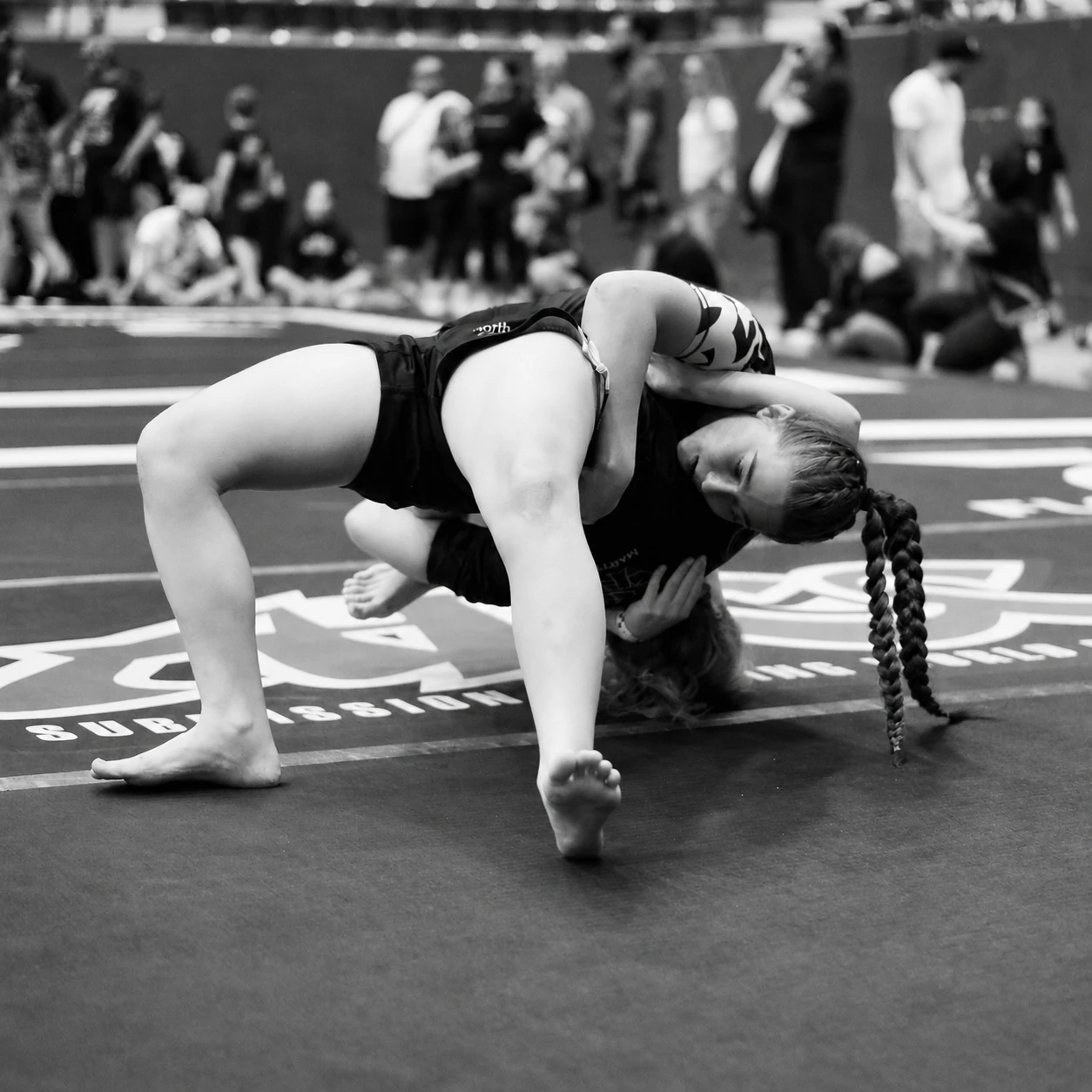
An invitation tells you who has been selected. An Open tells you who is still coming. Austin had room for both conversations on August 8, when competitors gathered at Luedecke Arena on the eve of ADCC Youth Worlds. For the young athletes outside the championship field, this was a chance to make the weekend matter anyway.
Kylie Keach made her case in the girls’ 15–17 advanced −55 kg division. Representing Pedigo Submission Fighting, she won gold ahead of Yunuen Cardenas and Jackie Fernandez. It was her seventh ADCC gold and her second consecutive advanced Open victory. That is a developing pattern, not just a good photograph with a medal.
The −55 kg teenage field has a strong argument for being one of youth grappling’s most demanding competitive neighborhoods. The appeal is the blend: enough speed to turn a small opening into a scramble, enough experience to punish a bad reaction, and athletes approaching adult-level physicality while still changing rapidly from one season to the next.
The Austin podium provides useful context for Keach’s win. Cardenas also took the girls’ 13–14 advanced −55 kg title that day. The older division therefore brought Keach together with a younger competitor who had already proved capable of winning her own advanced bracket. Fernandez rounded out the podium. The podium put Keach ahead of another advanced champion, giving the gold substance beyond the medal itself.
Elsewhere, Olivia Cook won girls’ 15–17 advanced −60 kg, with Charlotte Washack second and Kiara Liene Pereira Gonzales third. Raquel Herrera won the older girls’ advanced −50 kg class. On the boys’ side, Julian Castillo took the 15–17 advanced −60 kg title and Tristan Caballero won −70 kg. Austin offered several ways for young athletes to leave with a result worth building on.
Winning Austin did not automatically buy a future Worlds invitation. It did give athletes outside the championship field a chance to show what they could do, in the same city and on the same weekend that much of youth grappling was watching.
That distinction does not make the event less important. For an athlete who has spent the season trying to reach a championship, the wrong response to a closed door is to let somebody else’s selection calendar become the end of the training year. There are still opponents to beat and positions to improve. A difficult bracket can supply both motivation and a far more useful assessment than an argument about who should have received an invitation.
The adult results gave the weekend another layer. Dorian Olivarez won advanced −76 kg, while Daniel Deeder took −83 kg and Placido Santos won −91 kg. Abraham La Montagne won the advanced absolute. A youth competitor could compete in the same building where established and emerging adults were working through their own tests.
For Keach, the important word is consecutive. One win can announce ability; repeating the result begins to establish consistency. The next task is carrying it into deeper brackets, different opponents and the next selection cycle. Austin did not settle her ceiling. It supplied another reason to keep watching.